Search This Blog

Thursday, March 30, 2023

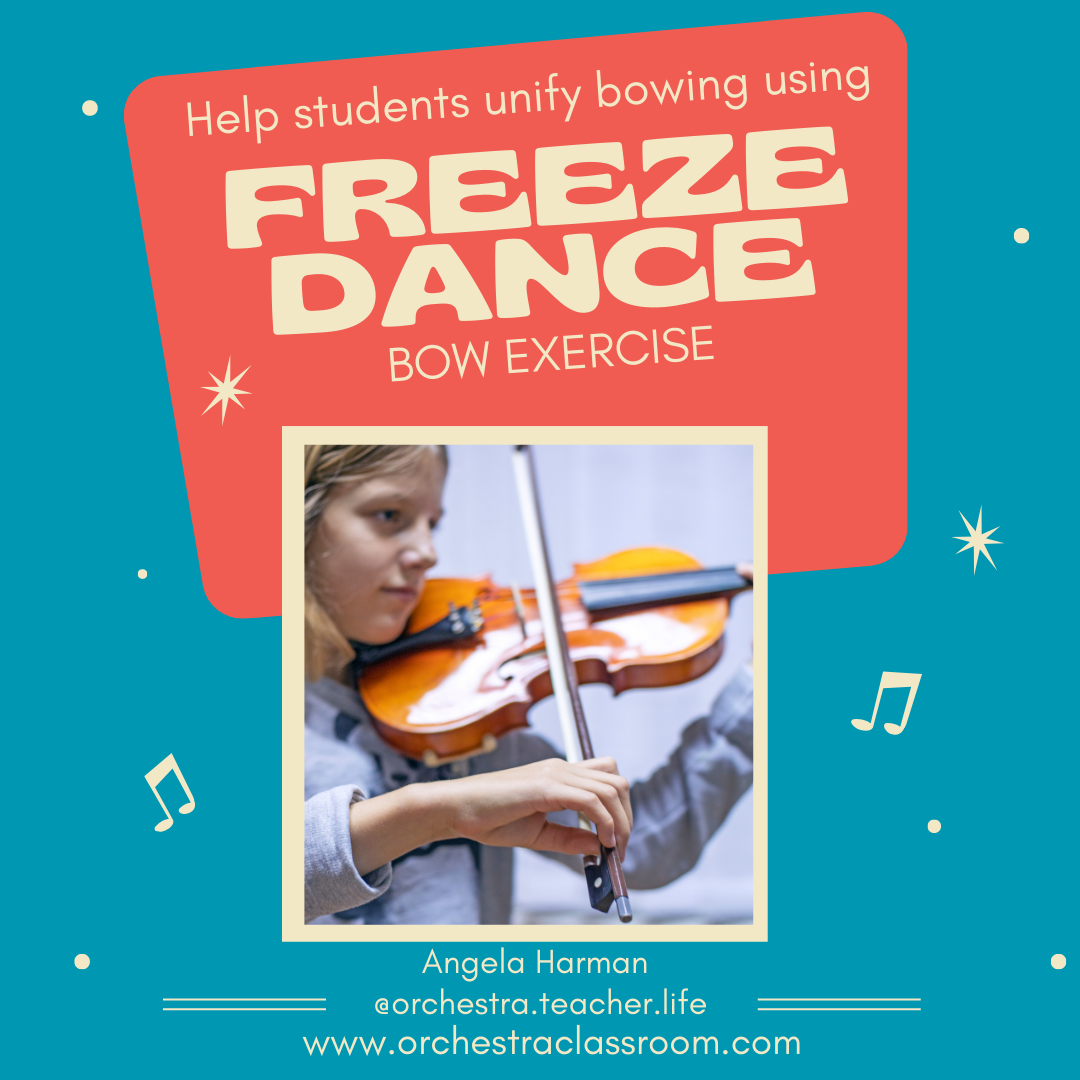
Freeze dance rehearsal game for unified bowing


This week I wanted my orchestra 2 (2nd year) orchestra students to work on unifying bow strokes.  We watched a performance from TwoSet violin where they played a duet and their bowing very well matched.  Even while playing different parts/notes, their bow strokes were unified: (watch just the first part when they were using full size violins).  We also talked about tone and how to get the most sound from our instruments...no matter the size.


We talked about the importance of unified bow strokes and having everyone use the same amount of bow as well as matching bow placement, weight, speed. etc.  To practice the skill, I selected short one measure rhythms from our concert music.  I then used a YouTube FREEZE dance video to practice each rhythm:


For example, all students should play one note - low A.  They all perform the same rhythm over and over (on low A) using the same bow strokes/same amount of bow until the video says to STOP/FREEZE.  Once frozen, all students check to see if they are in the same part of the bow as everyone else.  I paused the video as everyone froze.  I then demonstrated a new rhythm for the next portion of the freeze dance, so we worked on 6 different rhythms total.

This game worked really well to help students match bowing, be aware of others in the ensemble, and master rhythms from our music.  After playing this game, my students sounded much more unified in their concert music.

Thursday, March 16, 2023

St Patrick's Day in Orchestra


I don't normally celebrate St. Patrick's day, but my students have been working so hard to learn their music I feel like it's time for a Friday Fun Day game.  This game can really be modified to be played at any time, but a leprechaun theme makes it a little extra entertaining....you'll see why.  :)

This game takes very little prep work.  I already know the passages of music that have been difficult for students to master.  I created a few slides with note sequences from our concert music, but after those slides, I'll be having students play certain measures from their parts.  Here's how to play!


1. Make a wheel with 'leprechaun dares.'  These are things the teacher or a student volunteer will do IF students are allowed to spin the wheel.  I make wheels at pickerwheel.com.

Here are my leprechaun dares:

  • Skip around the room
  • Open the door and yell "I love Leprechauns!"
  • Dance to some Irish music for 30 seconds.
  • Walk to the office and tell them you've lost your gold.
  • Say something in an Irish accent.
  • Pass out gold coins to stellar students as they play correctly...
  • Direct the orchestra like a leprechaun
  • Try to distract the group as they play. If you see a mistake, you can take their gold coins.
  • Jump up and click your heels together while yelling, "It's an orchestra life for me!".
  • Find a leprechaun friend. Give them a headband to wear for the rest of the day.
  • Pick someone NOT wearing green dance with you. If they do it, give them a green necklace.
  • It's your lucky day! As students play, leave suckers on the seats of students who have great posture/position.

Here's a link to my wheel: https://pickerwheel.com/pw?id=K4j7Z


2. The whole class or a certain section will be called to to play specific measures as chosen by the teacher.  If they play correctly, the wheel can be spun and all can enjoy watching the student volunteer or teacher (as the'leprechaun') do the dare.  If not played correctly, the class will rehearse and fix the measures, but they will not get to spin the wheel.

3.  To make this extra funny, the teacher or the student volunteer can dress up in a costume.  I happen to have this hilarious costume already...

4.  I stopped by Hobby Lobby to buy a few extra props for the game:  Gold coins for the 'leprechaun' to pass out to stellar students, shamrock necklaces to pass out to students NOT wearing green, and festive green headbands for selected students to wear during some of the dares.

Saturday, March 11, 2023

Top Tech Hacks for orchestra teachers - time to sign up!

I just finished teaching Top Tech Hacks for orchestra teachers to learn how to create their own resources/worksheets/assessments and it was AWESOME! Can't wait to do it again. My first class sold out in less than 24 hours. Don't miss out! Here's a link to my next class! https://www.eventbrite.com/e/top-tech-hacks-how-to-create-your-own-orchestra-resources-tickets-582264136707


Saturday, February 25, 2023

Tech Hacks for Orchestra Teachers


Click here to enroll!


Have you always wanted to create your own awesome orchestra resources for your students?  I can show you how using Google Slides!  No add-ons, no expensive programs or software required.  (Though I will demonstrate options using Sightreadingfactory.com (free at first, $35 subscription for a year) and Flat for Education (free trial, then $2 per year).  

This course will give you ideas, know-how, and inspiration to create meaningful, relevant classroom materials for your students.  There are 6 segments in the course, each with an project where you will create your own resource:


1: Basic Settings to turn Slides into a powerful publishing tool
2: Make your own fingerboard worksheet
3: Create your own note-naming worksheet
4: Create your own rhythm assessment
5: Create your own sight reading or note assessment
6: Create your own custom practice assignment


CLICK HERE TO ENROLL!


Along the way, I will show you tips and hacks for creating professional-looking content in an efficient manner.


You will also receive FREE TEMPLATES to use as ideas or for building blocks in your own creations.


Only 15 spots open for this first class!  Reserve your space today!  This class is LIVE over Zoom. 

March 11, 8 am MST

https://www.eventbrite.com/e/top-tech-hacks-how-to-create-your-own-orchestra-resources-tickets-550163683387


Monday, February 13, 2023

Beginning Orchestra Valentines Note Reading Game


I know this is last minute...but here's a fun activity for Valentines Day for your beginning orchestra!  All you need is a set of 2 dice for every 2 people and some small conversation candy hearts (or other small candy..I'm using smarties).  

Access your free template HERE - Canva editable document

PDF download HERE

Friday, February 3, 2023

Fingerboard Geography Teaching Aid - Free!


If you teach in a classroom that has access to a smartboard or projector, here is a free tool for you!  I use this type of visual all the time in my orchestra classes.  I incorporate these slides into my daily lesson plan for students to practice various finger patterns. 

Simply drag and drop the notes/fingerings to the fingerboard.  Use as a teaching tool in your own presentations by screen snipping the graphic or copy/paste into your own google slide.   You can also use a copy of these slides as a template for online student worksheets.  For example, share a slide with students and have them drag and drop the notes for the D major scale.

Get yours FREE HERE!

Saturday, January 28, 2023

No more playing tests?


I've always been against traditional practice cards, but I have been a huge proponent of playing tests for years.  Ever since I first started teaching, I have assigned playing tests.  Some years, I held tests every Friday.  Some years I held a playing test every 2 weeks.  I've done playing tests in class...listening to each students one at a time.  I've done tests where I listen to small groups of students at once.  I've done tests using technology...spent hours listening to recorded playing tests.  Now, after many more years of teaching, I'm done with playing tests.  

What was my purpose of having playing tests?  To motivate students to practice specific music excerpts to make our music sound better.  To make sure students were progressing.  To push students to fix 'issues' in their playing.  To give feedback.  But do playing tests really accomplish all of those goals in an effective and efficient way?  There are many cons to regular playing tests.  1.  Playing tests take up a lot of valuable rehearsal time.  2. Students don't all prepare for playing tests.  Certain students always do well, while others consistently score poorly.  3. What do you do when a student plays poorly on a playing test?  Once they have a grade, it seems the test is over.  Music should be a refining process.  A test is not a final mark in ones playing ability.  I allowed students to retake playing tests, but most did not.  4.  I'll admit it... I hate grading playing tests. 


What I do instead...

1. Self Assessments

I want my students to be able to self-reflect on their own playing.  In order in improve, students must be aware of what/how they are playing in order to decide what to fix or change.  Frequent self-assessments promotes student ownership and accountability.  They know what is expected and where they stand.  Self-assessments are quick and take very little class time.

                        Sample:


2. Peer Assessments

Instead of using an entire rehearsal for playing tests, I have students grade each other using very specific rubrics.  We practice using the rubric as a class by having students grade me.  Students listen to each other and circle the scores on the rubric.  I love doing peer assessments because they don't take very much time.  Stand partners actually talk to each other and help each other and I believe it creates a team dynamic.  It helps students realize all are students need to master the skills for our group to succeed.  At the end of the rubric, I ask a few questions:  1.  Do you agree with your stand partner's assessment of your playing?  2.  What did you do well?  3. What do you need to work on?  Do you need help? 

                    Sample:


3.  Guided Practice

When I want students to master a specific challenging passage in our music, I create guided practice sheets.  During class, students spend 15-20 minutes going through the practice sheet.  By the end, students have drastically improved.  After one guided practice assignment, one of my students said, "This is witchcraft!  You should make these sheets more often.  I'm so much better at playing that part now!"

                Samples:


Saturday, January 21, 2023

8 ways to maintain engagement during rehearsals


There are times during rehearsals when some sections need to wait while another section receives special help and instruction. Students do need to learn proper rehearsal etiquette and know how to sit quietly with their instruments.  But too many episodes of sitting/not playing can make rehearsals drag on and on.  


Every rehearsal will likely have moments when some students are not playing, however, there are many ways to include all students in the rehearsal process.  Including all students increases engagement, builds a culture of team responsibility, and creates a more immersive rehearsal experience. It also helps with classroom management since students are too busy to begin off-task behaviors.   As often as possible, I find ways to include all students at all times.  Here are some ideas for including all players while rehearsing one section at a time...


Thursday, January 12, 2023

Rehearsal Game for Orchestra to help students master tricky measures

My orchestra classes have been tirelessly working on concert music to perform in a few weeks.  They're doing a great job and I feel our music is mostly ready.  There are just a few measures here and there that I still visit and work in rehearsals.  Today, I created a game to get students practicing those final tricky measures.  It worked so well!  Students played the game with their their stand partners.  It was interesting to see what measures they chose to have each other play.  They were exactly what I wanted them to practice!  And it turned into a great practice exercise because they had to play any missed measures together five times.  If students tied, they kept playing until the tie was broken.  Students who won the game got a small treat.  

I used a worksheet for students to fill out that shows the measures chosen and helped track the points.  I copied the worksheet on both sides of the paper, so students could keep playing if there was time, or settle tied scores.

Click HERE to access the worksheet with game instructions for students.


Monday, January 2, 2023

Drone Song for Beginning String Orchestra grade .5


Tired of Twinkles?  Here's a great first-ensemble piece for your beginners.  This piece is very simple, grade .5 with the following skills: quarter notes, half notes, whole notes, Notes: D, E, F#, G, A. Violin and viola sections play in unison and cello/bass play in unison. This makes the piece quick to put together.  Let students experiment and decide on dynamics.

Parts included: Score, Violin, Viola, Cello, Bass.


Listen here.


TPT Link HERE


Saturday, December 31, 2022

New Years FREEBIE for your first day back to school


Hopefully your beginners practiced during the holiday break, but if not, here's a fun activity for the first rehearsal back to school...FREE!  All you need is a set of dice for every 2 students.  Or, you can use one set of dice and have the entire class work on the same exercises/activities at the same time.  This kind of activity is student-driven, freeing up the teacher for helping individual students or tuning troublesome instruments.  Get yours free HERE!