Search This Blog

Saturday, September 28, 2024

Games to reinforce rehearsal procedures and playing skills


For some background on this, I teach 364 students each day in 6 class periods at one school.  4 periods of beginning orchestra and 2 very large class periods of intermediate (year 2) orchestra.  On Tuesday this week, I had one class period that was extra wiggly and distracted.  They had been making excellent progress and I considered them to be one of my best sounding classes until this week.  As I reflected on what had caused this change, I realized it was because we needed to review rehearsal procedures.  I don't find it very effective to lecture students about following procedures, so I created a couple games to reinforce policies, and also help students focus on the skills we were working on in class.  These games went wonderfully and students want to play them again!  All of my classes are back on track!

GAME #1:  The Mean Game

I don't play this game very often because I do think it is a little mean and I don't want students to feel 'picked on.'  If played in a trusting, friendly classroom environment, it is very effective.

You don't have to do this part, but since it's close to Halloween, I ran out to Wal-Mart and bought some devil horns.  I dressed up like a devil wearing all black and fire sunglasses.  It was hilarious to watch students' reactions as they came into class.  They couldn't help but smile and be excited to find out what we were going to do.

When class started, I explained to them that we were going to play 'the mean game' and that is why I was dressed like a devil.  We talked about how when we were little kids, we would be mad when we lost a game and sometimes even rage quit.  I told them about how it's hard to lose....but this game is evil because my job was to try to make them all lose.  This helped set a good climate for the game. I didn't want students to get super sad if they messed up. 

Students had to follow the directions/challenges/expectations on each slide and if they were caught doing otherwise, my TA would put a little checkmark on their name on my seating chart.  (It helped to not have ME mark students on the seating chart as caught...I would recommend a student volunteer mark the names.)  We did not let students know if they were checked off...that way they needed to keep trying since they didn't know if they were ever caught.  My goal as the devil was to trick most of the class into making a mistake.  I gave out prizes based on how many students were 'out.'  (the prizes got better if more people were tricked and marked out).

This game can work for students of any level.  I tracked beginning students on:  Maintaining self-control in rehearsal (play on when directed, stop and start with conductor, follow directions promptly)

1. Following directions (students were instructed to do bow exercises with a student leader....I tried to distract them and follow me instead)

2. Bowing open strings - keeping bow hand set, bow strokes straight.  Stopping with conductor.  (I sneakily stopped playing now and then and they had to stop when I stopped)

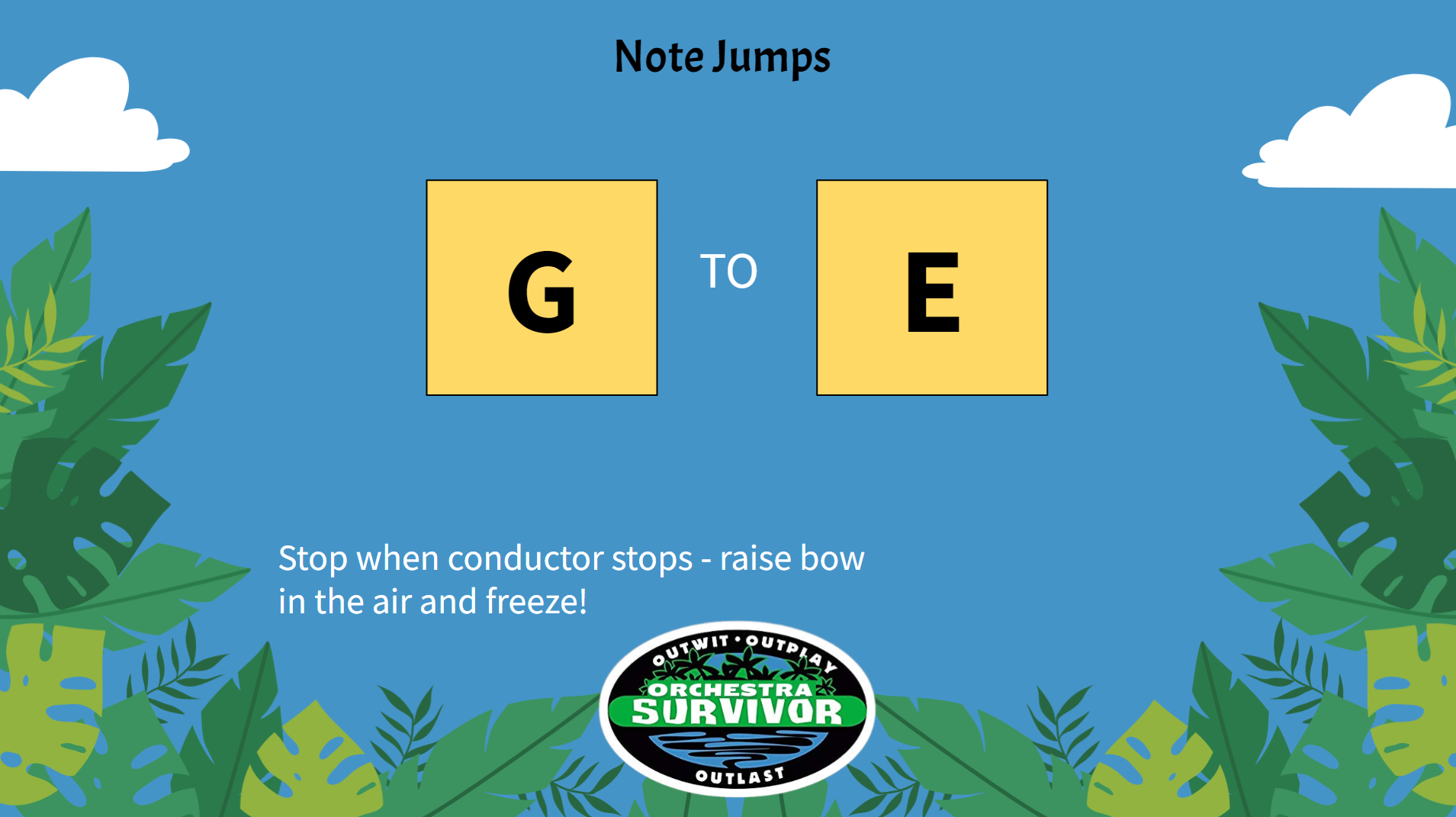
3. Play only when directed.  We practiced the D scale with a few variations.  Students were only allowed to begin playing if they heard the command 'ready, play.'  I tried to trick them by saying other words to start.  We also practiced 'note jumps' (just playing 2 notes back and forth over and over) and students to stop exactly with me.

4. Playing the correct line of music -not getting lost.  Students got WAY better at one of our concert pieces - Sourwood.  

5. Playing ON the tapes: We played 'Boil em Cabbage' and 'Twinkle' to see if students were landing on their tapes

6. Raising hands with questions:  I passed out new music: Tip Toe Concerto and had students look over and music and raise their hands with questions.  They had great questions and all were engaged without distraction.

At the end of class, you might point out how well students worked and focused.  Ask them if they played better during this rehearsal and ask what made the difference.  My students quickly realized that following rehearsal procedures was necessary to make more progress each day.  I used the same game with my Intermediate classes to reinforce rehearsal procedures.  I just changed the things I was watching for each round to be specific to our concert music (bows matching, notes in tune, stopping with conductor, etc)

GAME #2: Orchestra Survivor

Here's another game I used this week to reinforce rehearsal policies and reinforce skills.  I spent a couple hours creating ORCHESTRA SURVIVOR.  It's very similar to the mean game...just a little different spin.  We focused on many of the same skills, but instead of getting tricked or marked 'out,' they were trying to last to the end of each challenge.  I used a stop watch to time each challenge and at the end, students wrote on their scorecards how long they were able to maintain the skills.  It was difficult for students to track exactly how long they lasted on each challenge - so I will change this next time we play.  I think it would be much easier for students to fill in their scorecards with a symbols (+ means they lasted the entire challenge, a check mark means they lasted more than half way, a - for less than half, and a 0 if they didn't last very long at all.)

I created slides with little video clips of survivor challenges from the TV show to introduce our challenges.  We then practiced the challenges on the slides while students focused on 'surviving' or 'out-lasting' for the entire challenge.   I used the same basic slides for my intermediate class...I just changed the challenged to include specific measures from our concert music.

For my challenge 5, I wanted students to just focus on NOT GIVING UP!  We had a great discussion about feeling like an underdog and about how good it feels to improve and keep going, even if you get frustrated.  (Insert your own personal underdog story here.) We worked on our new piece and students made so much progress because they played with increased drive and determination.

Access your own SURVIVOR TEMPLATE HERE.

Scorecard PDF's:  Beginning, Intermediate

Here's a view of my beginner slides:


Thursday, September 26, 2024

Isty Bitsy Spider Halloween note reading activity


 Here's a fun way for beginners to practice the song 'Itsy Bitsy Spider.'  Let them figure out the notes and play it to see if they wrote the notes correctly!  Includes parts for violin, viola, cello and bass!

FREE HERE!

Sunday, September 15, 2024

Free Halloween Music for beginning orchestra


It can to tricky to find music for beginning orchestra for a first concert in October.  My beginners can play Twinkle Twinkle Little Star, and they could use some practice at reading the notes we have learned so far.  This piece uses the same notes from Twinkles:  D, E, F#, G, A, and B.  The rhythms are easy and quickly learned.  Students learn dynamics, and they learn how to make a cool sound effect (pizz and slide).  I have included parts with regular notation for students who are fast at note reading and also parts with simplified notation (note names in note heads) for students who are still learning the staff.

Click here for the audio (there are some pizzicato notes in the audio that aren't quite accurate because they are supposed to be a sound effect...students pizz once and slide their finger up their highest string to make a funny sound...you'll see it in the score)

This is FREE!  Click here to download it today!  

Saturday, August 31, 2024

The first 2 weeks of beginning orchestra


On Friday, my students finished their first 2 weeks of playing instruments.  They have been FLYING in their progress and I've been enjoying helping them learn and grow musically.  I started to think of all of the concepts they have learned and are practicing to refine so far.  It's quite a list!

1. Bow holds on straws
2. Bow holds on pencils
3. Bows holds on bows
4. Bow exercises
5. Instrument care
6. Instrument parts
7. Rest position
8. Instrument set up
9. Ready position
10. Play position
11. Pizzicato
12. Rock n rolls: bow placement
13. Bow weight, bow speed
14. Open strings
15. Arco open strings
16. Left hand placement
17. Placing 1st and 2nd finger
18. Drawing note heads, music staff
19. Note reading open D and A
20. Tune: Burnt Cross Buns
21. Tune: Mary Had A Sad Little Lamb
22. Tune: Sourwood Mountain - open strings with slaps on strings

I posted some pics and videos on Instagram to celebrate their progress and I felt like some people didn't believe my beginners were really learning/mastering all these skills ...that it wasn't possible.   These are the skills I have covered with my classes so far and we practice them each day.  Are all of my beginners doing each of these things to the level of 'professional' mastery?  Not always.  But you should see the videos. Are they making amazing progress?  YES!  I'm watching them hold their bows and I am proud to see most students with great form.  They are plucking their strings with good position because we practice it that way.  They are bowing on their strings with sometimes straight bows...sometimes scratchy...they are figuring it out. We are constantly learning and refining.  When I take pics and videos of my class, I'm excited when I see their results!  My students are motivated to learn correctly because I have taught them that it matters.  

When I make lesson plans, I use google slides to create my lesson flow and provide students with all the information, videos, content, and visuals.  I would like to share the slides I used for my first 2 weeks of playing.  I thought it would be useful for teachers to see how each lesson was laid out and what students practiced each day in rehearsals.  This does not mean my first 10 days of playing will look like everyone else's first 10 days.  I tend to have fast paced rehearsals with a lot of action/playing. We all teach in different circumstances, different age groups, varying schedules.  All of these things affect how much we can teach in each rehearsal.  I hope this provides some ideas for others as we work to teach our beginners to learn effectively.

Friday, June 28, 2024

Fortnite for Orchestra - A Rehearsal Game


My students LOVE it when we play rehearsal games!  It's a great way to increase student engagement and focus on specific skills.  Fortnite is huge right now and it was really fun making this Fortnite inspired game.  I hope you like it!   

I designed the game in Google Slides.   It's fully editable - so teachers can change the notes, excerpts and rhythms as needed.  I used screenshots or 'music snippets' for each of those.  Best of all....It's FREE!

CLICK HERE  to access your free download


Monday, June 24, 2024

Empowered Note Reading for String Orchestra


I'm so excited...IT'S FINALLY FINISHED!  I've been working on this project for quite awhile and I can't wait to use it with my students.  My students do a lot of bell-work activities at the beginning of class and it's been working well to use that time for students to practice writing rhythms or note names.   It's a great way to help students learn notes...BUT...students need more than worksheets.  I have noticed my students get very good at writing note names and learning notes on paper.  When it comes to actually PLAYING those notes, the skill doesn't always transfer as quickly.  Students need practice to build note reading skills and that is what this resource is all about.  It's also about students taking on ownership and accountability for their progress.  That is why there are so many embedded self-assessments, questions for reflection, and multi-level parts.  I wanted to create something that could be challenging for students who had music/piano experience and those with none.  We can't expect all students to learn at the same rate, but we can help students work and progress on their level.  Also included in this resources are short pieces that can be used in performance.

Here the info and link to TPT!  CLICK HERE

Students need to PRACTICE note reading using a step by step process. This is a packet for beginning string orchestra and includes a 45 page book for violin, viola, cello, and bass (180 pages total!) This workbook empowers and motivates students to master note reading by utilizing student choice, multi-level parts, targeted practice, creative exploration, and self-assessment. AND, all strings are included in the resource! Violin and bass students practice notes on G, D, A, E. Viola and cello students practice notes on C, G, D, A.


Wednesday, June 5, 2024

FREE Warm up challenge for beginning orchestra


Do you know what students need more of?  CHOICE!  To motivate students, they need to develop ownership of their playing and progression.  One way to intrinsically motivate students is to provide options and allow students a voice in the learning process.  I just designed this beginning orchestra warm up game called WARM UP ROULETTE!  Try it!  Let me know how it goes.  

CLICK HERE TO PLAY!

(It's like a slide show, so viewing it works best from a computer.)

Saturday, May 25, 2024

New music for VERY beginning orchestra


One thing I always wish for at the start of each school year is more VERY EASY beginning orchestra music for our first concert.  Our first concert is always at the end of October.  By that time, students are just solidifying note reading on the D string (perhaps some A string notes as well).  They have learned the standard rep all beginners have learned...Mary Had a Little Lamb, Twinkle, etc....but those tunes are so short (thought we often do perform those at our concert...there's time for them to perform everything they have learned!)   I also want them to learn a more substantial piece for their first concert.  At that time in their development, grade 1 music is too difficult.  I need music that is quick teach and enforces skills they have learned in their first couple of months.

Here are a couple of pieces I just finished:

1. The Champion (click title to view on TPT)

This piece uses only 5 notes: D, E, F#, G, and A.  The rhythms are simple.  Learning this piece will help reinforce note reading on the D string.  Dynamics were omitted on purpose.  You can use this piece to teach dynamics!  Let students decide when they would like to play soft or loud in order to 'tell a story.'  Notes on the page are slightly enlarged to help with note reading.  Score are parts for violin, viola, cello, and bass.

Here's the audio: https://drive.google.com/file/d/1c_bUYQnzxeBxmLGlCVQD-Y7gXljfCU7t/view?usp=drive_link

2. Night Quest (click title to view on TPT)

This piece uses only 6 notes: D, E, F#, G, A, and B. It's quick for beginners to learn because of the repeating phrases between the violin/viola and cello/bass part. Students and learn similar sections in unison, then put it all together.  Score are parts for violin, viola, cello, and bass.

Here's the audio file: https://drive.google.com/file/d/1d14ImMYZ_KebR7hDXDq8nQNdJ4yHCHwI/view?usp=sharing


Saturday, April 20, 2024

Practice Challenge using Google Forms

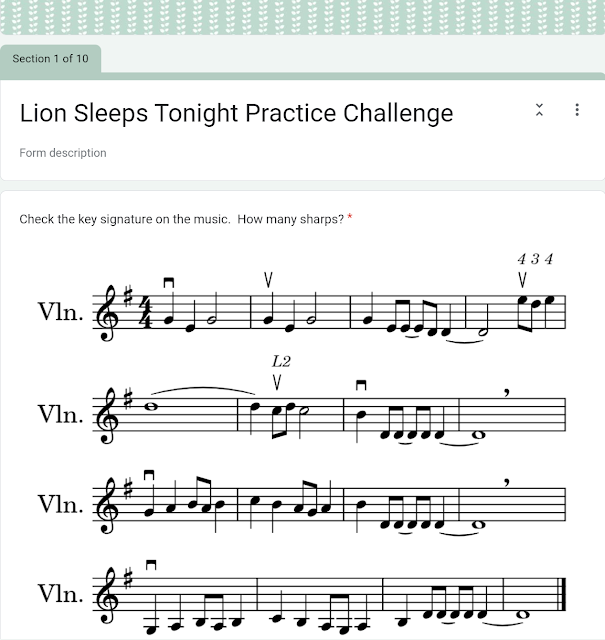
 I've been working on creating this practice challenge to help my students finish learning one of our concert pieces: Lion Sleeps tonight.  I occasionally do practice activities in class for 10-15 minutes of rehearsal time.  This enables me to teach students how to practice, give them time to practice, and help them see the benefits of practicing (they can immediately hear/feel a different after these guided practice sessions).  Normally I made worksheets or games for guided practice time...but I had an idea to us a google form.  Students have to look at the music and answer some questions before they practice. Students are able to track and report their accuracy on their reps and reflection on their progress.  The music is all embedded in the form.  Students have to answer questions correctly in order to move forward on the form.

Check out a sample HERE and see what you think!


Sunday, March 24, 2024

Orchestra Stars the GAME!


I've been away from my students for a few days while I attended a conference.  Since I don't really know what (or how) they've been playing while I was away, I want to do an activity to reinforce good behavior and good practice.

I just designed this game called ORCHESTRA STARS.  In this game, the 'heart' icons are lives and students lose them if they are plucking or playing out of turn. It's a fun way to reinforce proper rehearsal protocols if you have students who ever play when they are not supposed to... :) Students earn bonus points (stars) for playing with proper posture and with quality intonation. 

CLICK HERE FOR YOUR FREE DOWNLOAD!

FREE for a limited time!  Simply use the template to fill in your own warm-ups, method book lines, or measure numbers from your concert music. Students play the assigned music for each round 3 times. They earn one star for each time they play correctly. Student with the most stars wins!  Games like this really help students stay focused during rehearsals.


Sunday, February 11, 2024

Orchestra Rehearsal the GAME activity


It's fun making interactive games using Google Slides! I just made a new one called 'Orchestra Rehearsal: The GAME.  It's designed as a retro video game because I wanted to use the idea the 'hearts' as lives in the game...just like old Super Mario and Zelda games.  Students have to beat the game by 'defeating' bad position, poor tone, and mastering tricky measures from our music.  Because this was made with google slides, it is really easy to make changes and adjust the slides to work with any music we are rehearsing.  I opted to use note names, but it would also be really easy to use the Music Snippet add-on to insert music notation.

To play the game, the teacher clicks through the slides as indicated on the screen.  The teacher judges whether the students 'lose a life' or not...and can take away lives by simply clicking on the hearts on the screen.

This is a great game to use any time...and especially Valentines because you can challenge student so not lose their hearts!

Check out a preview HERE.

Available on TPT!


Saturday, January 6, 2024

New Year Workout for Beginners


Here's the thing about going back to school after Christmas break....most of the students (and even many of the teachers) are sad to be back to school!  It's an adjustment to get back into a routine....practicing....homework....sitting through classes all day long.  

I'd like my first day back with my students to set a tone.  I want them to remember how much fun we have together, how we work hard to make progress, and how music is important in our lives.  Recently I was reading some articles about the impact of music education and I found this quote so interesting:


I feel a responsibility to do all I can to help my students thrive and succeed in music.

For my video of the week, I'll be showing parts of this video about a kid trains and pushes himself to achieve his goal to run 100 miles:  https://www.youtube.com/watch?v=Rfb1idsl2AE&list=PLdKxs7i55u4FZW_fqjMHDjJB9I6lNXm56&index=74

For our warm-up, I'll stick to a work-out theme to help students get back into shape for the New Year.  We will review some of the skills we were working on before break.  I want it too feel like training exercises so I'll be timing them to see if they can complete the note reading and rhythm activities quickly.   

For a limited time, you can download this activity for free!  Visit my TPT STORE for your download.


After the warm-up, we'll have fun learning/review exercises from the method book and concert music.  I'll using my new GIANT sized UNO game to keep students engaged.  The numbers on the cards determine how many reps students need to play.  I'll be carefully selecting the measures and rehearsal excerpts so students are practicing exactly what I need them to accomplish.