Search This Blog

Saturday, February 25, 2023

Tech Hacks for Orchestra Teachers


Click here to enroll!


Have you always wanted to create your own awesome orchestra resources for your students?  I can show you how using Google Slides!  No add-ons, no expensive programs or software required.  (Though I will demonstrate options using Sightreadingfactory.com (free at first, $35 subscription for a year) and Flat for Education (free trial, then $2 per year).  

This course will give you ideas, know-how, and inspiration to create meaningful, relevant classroom materials for your students.  There are 6 segments in the course, each with an project where you will create your own resource:


1: Basic Settings to turn Slides into a powerful publishing tool
2: Make your own fingerboard worksheet
3: Create your own note-naming worksheet
4: Create your own rhythm assessment
5: Create your own sight reading or note assessment
6: Create your own custom practice assignment


CLICK HERE TO ENROLL!


Along the way, I will show you tips and hacks for creating professional-looking content in an efficient manner.


You will also receive FREE TEMPLATES to use as ideas or for building blocks in your own creations.


Only 15 spots open for this first class!  Reserve your space today!  This class is LIVE over Zoom. 

March 11, 8 am MST

https://www.eventbrite.com/e/top-tech-hacks-how-to-create-your-own-orchestra-resources-tickets-550163683387


Monday, February 13, 2023

Beginning Orchestra Valentines Note Reading Game


I know this is last minute...but here's a fun activity for Valentines Day for your beginning orchestra!  All you need is a set of 2 dice for every 2 people and some small conversation candy hearts (or other small candy..I'm using smarties).  

Access your free template HERE - Canva editable document

PDF download HERE

Friday, February 3, 2023

Fingerboard Geography Teaching Aid - Free!


If you teach in a classroom that has access to a smartboard or projector, here is a free tool for you!  I use this type of visual all the time in my orchestra classes.  I incorporate these slides into my daily lesson plan for students to practice various finger patterns. 

Simply drag and drop the notes/fingerings to the fingerboard.  Use as a teaching tool in your own presentations by screen snipping the graphic or copy/paste into your own google slide.   You can also use a copy of these slides as a template for online student worksheets.  For example, share a slide with students and have them drag and drop the notes for the D major scale.

Get yours FREE HERE!

Saturday, January 28, 2023

No more playing tests?


I've always been against traditional practice cards, but I have been a huge proponent of playing tests for years.  Ever since I first started teaching, I have assigned playing tests.  Some years, I held tests every Friday.  Some years I held a playing test every 2 weeks.  I've done playing tests in class...listening to each students one at a time.  I've done tests where I listen to small groups of students at once.  I've done tests using technology...spent hours listening to recorded playing tests.  Now, after many more years of teaching, I'm done with playing tests.  

What was my purpose of having playing tests?  To motivate students to practice specific music excerpts to make our music sound better.  To make sure students were progressing.  To push students to fix 'issues' in their playing.  To give feedback.  But do playing tests really accomplish all of those goals in an effective and efficient way?  There are many cons to regular playing tests.  1.  Playing tests take up a lot of valuable rehearsal time.  2. Students don't all prepare for playing tests.  Certain students always do well, while others consistently score poorly.  3. What do you do when a student plays poorly on a playing test?  Once they have a grade, it seems the test is over.  Music should be a refining process.  A test is not a final mark in ones playing ability.  I allowed students to retake playing tests, but most did not.  4.  I'll admit it... I hate grading playing tests. 


What I do instead...

1. Self Assessments

I want my students to be able to self-reflect on their own playing.  In order in improve, students must be aware of what/how they are playing in order to decide what to fix or change.  Frequent self-assessments promotes student ownership and accountability.  They know what is expected and where they stand.  Self-assessments are quick and take very little class time.

                        Sample:


2. Peer Assessments

Instead of using an entire rehearsal for playing tests, I have students grade each other using very specific rubrics.  We practice using the rubric as a class by having students grade me.  Students listen to each other and circle the scores on the rubric.  I love doing peer assessments because they don't take very much time.  Stand partners actually talk to each other and help each other and I believe it creates a team dynamic.  It helps students realize all are students need to master the skills for our group to succeed.  At the end of the rubric, I ask a few questions:  1.  Do you agree with your stand partner's assessment of your playing?  2.  What did you do well?  3. What do you need to work on?  Do you need help? 

                    Sample:


3.  Guided Practice

When I want students to master a specific challenging passage in our music, I create guided practice sheets.  During class, students spend 15-20 minutes going through the practice sheet.  By the end, students have drastically improved.  After one guided practice assignment, one of my students said, "This is witchcraft!  You should make these sheets more often.  I'm so much better at playing that part now!"

                Samples:


Saturday, January 21, 2023

8 ways to maintain engagement during rehearsals


There are times during rehearsals when some sections need to wait while another section receives special help and instruction. Students do need to learn proper rehearsal etiquette and know how to sit quietly with their instruments.  But too many episodes of sitting/not playing can make rehearsals drag on and on.  


Every rehearsal will likely have moments when some students are not playing, however, there are many ways to include all students in the rehearsal process.  Including all students increases engagement, builds a culture of team responsibility, and creates a more immersive rehearsal experience. It also helps with classroom management since students are too busy to begin off-task behaviors.   As often as possible, I find ways to include all students at all times.  Here are some ideas for including all players while rehearsing one section at a time...


Thursday, January 12, 2023

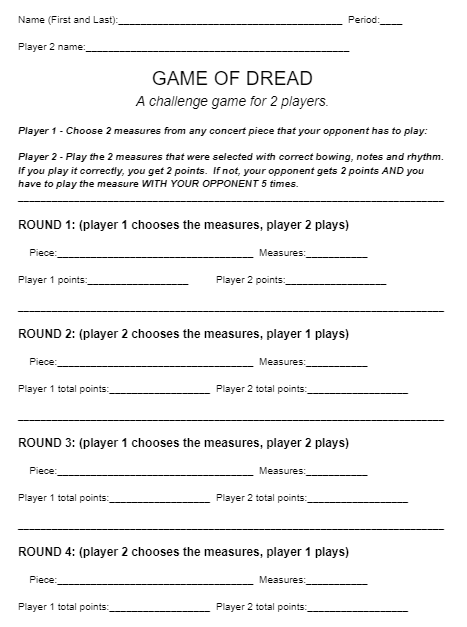
Rehearsal Game for Orchestra to help students master tricky measures

My orchestra classes have been tirelessly working on concert music to perform in a few weeks.  They're doing a great job and I feel our music is mostly ready.  There are just a few measures here and there that I still visit and work in rehearsals.  Today, I created a game to get students practicing those final tricky measures.  It worked so well!  Students played the game with their their stand partners.  It was interesting to see what measures they chose to have each other play.  They were exactly what I wanted them to practice!  And it turned into a great practice exercise because they had to play any missed measures together five times.  If students tied, they kept playing until the tie was broken.  Students who won the game got a small treat.  

I used a worksheet for students to fill out that shows the measures chosen and helped track the points.  I copied the worksheet on both sides of the paper, so students could keep playing if there was time, or settle tied scores.

Click HERE to access the worksheet with game instructions for students.


Monday, January 2, 2023

Drone Song for Beginning String Orchestra grade .5


Tired of Twinkles?  Here's a great first-ensemble piece for your beginners.  This piece is very simple, grade .5 with the following skills: quarter notes, half notes, whole notes, Notes: D, E, F#, G, A. Violin and viola sections play in unison and cello/bass play in unison. This makes the piece quick to put together.  Let students experiment and decide on dynamics.

Parts included: Score, Violin, Viola, Cello, Bass.


Listen here.


TPT Link HERE


Saturday, December 31, 2022

New Years FREEBIE for your first day back to school


Hopefully your beginners practiced during the holiday break, but if not, here's a fun activity for the first rehearsal back to school...FREE!  All you need is a set of dice for every 2 students.  Or, you can use one set of dice and have the entire class work on the same exercises/activities at the same time.  This kind of activity is student-driven, freeing up the teacher for helping individual students or tuning troublesome instruments.  Get yours free HERE!


Friday, December 30, 2022

New music for beginning orchestra!


I've been wishing for the perfect concert music for beginners, so I wrote some! 


I'm no Richard Meyer or Soon Hee Newbold, but I have a lot of experience teaching beginning strings and I know how hard it is to find the perfect piece for a concert. Beginners are learning so many new skills. It is important to choose concert music that reinforces those skills. Since there is much to learn, I like to have my beginners play concert music that is quick to put together.  Students feel great when they get a real piece of music they can actually play!  A piece that focuses on just a few notes and a few simple rhythms is great for beginners.  

My new music is very attainable and easy to learn because all parts take turns playing the various melody/harmony lines. That means students can practice the same melodies and harmonies before putting it all together. When rehearsing, have students practice all matching measures until they are comfortable with the notes and rhythms. Next, put it all together and it works up very quickly! 

Five Note Ramble for Beginning Orchestra - grade .5

This piece drills only 5 notes - D, E, F#, G, A.  All rhythms are simple.  All instruments gets the main melody/harmony lines at some point. 


Catalyst for Beginning Orchestra - grade 1

This piece is fast paced, set in e minor. All notes are on the on the D string and A string (D string and G string for basses). Rhythms included quarter notes, eighth notes, half notes, whole notes, and rests.  All parts share the same melody/harmony lines at some point, so it works up very easily.

Tuesday, December 20, 2022

Christmas lesson plan no instruments!


Last day before Christmas break and students want to play a game.  Many are absent because they had family plans/vacations...so it seems unproductive to have a regular rehearsal.  So we'll play my favorite game!  I love this game because once students know how to play, they can do it themselves. It frees me up to get some work done and get my classroom ready for the new year.  Students love the game and it promotes friendship and team bonding.  Access for free HERE!


Tuesday, December 13, 2022

Give students time to CREATE - favorite websites for music creation


Once a week, I do a 'Flex' day in my orchestra classes.  This is 20 minutes of time devoted to helping struggling students, allow students to complete missing work, and provide enrichment activities for students who need no help from me.  I have grown to love my flex days.  Many of my students have found a new passion for creating music because of the time they get to spend exploring various websites. Here are my favorites....   (as a side note, these sites are GREAT for sub plans!)

Turn everyday sound effects into music:  https://experiments.withgoogle.com/ai/drum-machine/view/


Lots of settings here to create music.  For a challenge, try to re-create a recognizable tune:  https://music-grid.surge.sh/#0-0-0-0-0-0-0-0-0-0-0-0-0-3072-&200&pentatonic


Links to an external site.

Make your own grooves to use as metronome:  https://drumbit.app/

Blob opera:  https://artsandculture.google.com/experiment/blob-opera/AAHWrq360NcGbw?hl=enLinks to an external site.


Make a Line Rider music video:  https://www.linerider.com/Links to an external site.


Turn text into music.  Send kind musical notes to friends or teachers.:  https://typatone.com/


Links to an external site.

Write your own song:  www.flat.io Links to an external site.  - $2 per student account - way worth it!


Type a drum beat - turn text into a groove.  Save the link and send to friends for a 'groovy' message:  http://typedrummer.com/


Links to an external site.

Groove pizza - create your own slices of music:  https://apps.musedlab.org/groovepizza/?museid=2UukWOCfA&Links to an external site.


If you like Mario, you'll love this:  Mario Sequencer:  https://minghai.github.io/MarioSequencer/


Links to an external site.

Turn keyboard into a piano. Record a song and email it to friends:  https://dotpiano.com/

Saturday, October 29, 2022

Emoji Game for Orchestra


Need a fun rehearsal game?  I like the emoji game because it works for any holiday!  I'm using this game for Halloween.  As an intro to the game, students could watch the following video featuring Hilary Hahn and TwoSet violin playing a game where they have to guess the emotion being played.


In my free online EMOJI ORCHESTRA GAME, students perform the challenge the corresponds to the emoji.  Send one or two students to the hall while the class or the teacher chooses an emoji from the game board.  


Click on the emoji to show the class the challenge that corresponds to that emoji.  Next, click on the emoji to return the screen back to the main game board.


Don't forget to click on the emoji to return back to the main game board!

Have students come in from the hall and have the class perform the challenge using any music your class is working on.    Students from the hall then must guess the emoji based on what they heard.  You can form teams and keep score if you want.


CLICK HERE TO PLAY!