Search This Blog

Sunday, May 21, 2023

End of Year Review notes and rhythm


Here's a simple, easy activity you can do with your beginning orchestra students to review notes and rhythms at the end of the year.

Teachers clap (or perform) the appropriate rhythm as listed on the answer key. Students determine which rhythm was clapped and use the letters next to the rhythm to de-code the words. Students practice note reading by drawing the notes on the staff. Fun, simple activity with no prep required!

FREE for a limited time HERE!


Saturday, May 13, 2023

Last days of school - orchestra lesson plans

 It's the last 2 weeks of school for me! I like to make sure students are engaged and busy through the end of the year.  Otherwise teaching can start to feel too much like babysitting teenagers.  Here are my plans for the rest of the year!


Some have asked how to play Apples to Apples orchestra edition.  Here's a tutorial:


Thursday, May 11, 2023

Instrument Switch-a-roo Day


 Through-out the school year, my students beg to try and play different instruments. I always promise to let them try a different one at the end of the year.  In the past, I very informally allowed students to trade instruments with others in the class and I taught them how to play Bile Em Cabbage.  This year I am going to teach them much like real beginners, but covering the basics very quickly.  By the end of the class period, I am hoping students will be able to perform Twinkles on a different instrument with correct notes/fingering and decent tone.  I won't be using any music stands and don't want the hassle of passing out music, so I will use a Google Slide presentation to get them going.

Free to use HERE 


And if you teach beginners and want to start the next school year flying, you'll love my resource called 'From Rote to Note.'  It's AWESOME for starting beginners and I use it every year to get my students playing right away.  We finish that book before cracking open the method book.


Tuesday, May 2, 2023

Rehearsal games for the weeks before concert


My concert is just a week away!  I feel my students are ready and will have a successful, rewarding experience.  To make sure they are ready, we've been playing rehearsal games.  These games are fun, but also very telling.  They help me and students know which passages need extra practice.  We then target our rehearsals to meet the needs of students.

Here are the games we've played lately:

1. DRAW A FACE

This is a very simple game with no prep work or set up time required.  I drew 3-4 circles (or face shapes) on my smart screen (you can use a white-board or chalk board).  I told students the faces represented our audience.  One student was chosen to draw faces on the circles as we played half of a concert piece to demonstrate how they feel we sounded.  Sometimes happy faces to demonstrate how well we played...sometimes barfing faces to show we played some out of tune notes.  After playing, the student who drew the faces would explain the inspiration and reasons for drawing each particular facial expression.   If there were things to fix, we worked on them before moving on to the next piece.  It was a great way for students to imagine playing for a live audience and think about how people could react to our performance.  They want to do their best and they worked very hard to perfect their playing.


2. SABOTAGE

We did this game by dividing the class into 2 teams: Violins and Viola/Cello/Bass.  I chose short passages of our concert music for each team to play.  The opposite team got to choose one 'secret weapon' to attempt to sabotage the other group and get them to play incorrectly.  Each group was only able each secret weapon one time, so they had to strategize the best time to use each weapon according to the passages I chose from the music.  This helped students focus intently on their playing and work through distractions.  


3. NAILED IT


This game was inspired from a cooking show on Netflix called 'Nailed It.'  Contestants in the show have to attempt to replicate professional looking cakes and treats.  In class, students had to attempt to replicate 'professional' playing.  I created slides with a series of short snippets from our concert music.  I played the snippet first, then the students all echoed the notes back, trying to match intonation, bowing, and rhythm.  They got a point each time they were successful.  We did variations of this game for a week.  On the first couple of days, I had the entire class play the snippets at the same time and gave the class a point for each time they played correctly.  Later in the week, I only gave points in they got it right on their first try.  On the last day, students did the challenge with themselves and kept track of the their own points.


Friday, April 7, 2023

Create your own resources - FULL COURSE


NOW AVAILABLE

TOP HECK HACKS:  How to create your own orchestra resources using google slides.

This will be one of the most beneficial classes you've ever done. Check it out!

https://www.teacherspayteachers.com/Product/Top-Tech-Hacks-How-to-create-your-own-orchestra-resources-FULL-COURSE-9380245


This is a full course with presentation, over one hour of video instructions, and practice assignments for you to learn how to create your own worksheets, assessments, practice drills and more!

No expensive software is required. We will explore Google Slides, Rhythm Randomizer, Sight Reading Factory, and Flat for Education. There are 6 segments in the course, each with an project where you will create your own resource:

1: Basic Settings to turn Slides into a publishing tool

2: Make your own fingerboard worksheet

3: Create your own note-naming worksheet

4: Create your own rhythm assessment

5: Create your own sight reading or note assessment

6: Create your own custom practice assignment

Along the way, I will show you tips and hacks for creating professional-looking content in an efficient way.

You will also receive 9 TEMPLATES to use as ideas or for building blocks in your own creations.

To use the course, click the links on the slides to access video instructions and assignments. Complete it at your own pace by pausing the video and practicing each skill. It takes approximately 2 hours to complete the course. At the end, you can print a certificate of completion for PD credit.

Tuesday, April 4, 2023

Conference Presenter for Orchestra Sessions


Maybe I'm weird, but I love presenting.  I have very high standards for my presentations and I strive to make each one relevant, useful, engaging, and inspiring.....never BORING and NO SALES PITCH.  I've presented at many conferences/events including:  National ASTA 2022, National NAfME Conference 2015, 2016, 2017, state conferences in Utah, Delaware, New Mexico, Oklahoma, and district events in a number of locations in the US and beyond.  Email me today to inquire about dates!  I'm already beginning to fill my 2023-24 calendar!

Saturday, April 1, 2023

Re-framing playing tests and assessments


I spent years doing playing tests.  My first year teaching, I did a playing test every single Friday.  It was great!  I taught 4 lessons per week, then on Friday it was like I got a break.  Just sitting down, listening to students play one by one....very chill.  For me, at least.  After a couple years, I started doing playing tests less often.  Once every 2 weeks.  Then once a month.  Now?  Hardly ever.  Some may find that shocking.  How do I grade my students!?  I have a lot of opinions about playing tests, assessments and grading.  I've spent years experimenting, reflecting, and adjusting.  In this post, I will address some of the things I've learned and share reasoning for my recent changes in how I do playing tests.

Each year, my school district has teachers fill out a self-evaluation so we can assess teaching standards and make goals to improve.  There are quite a few questions in the evaluation regarding differentiation and meeting the needs of all students.  I started to make goals to work on this area in my teaching, but was really grappling with how to do it.  Students learn at different paces.  Some need lots of help and extra practice, some seem to excel on their own, some need a challenge, some need simplified materials.  It's a lot to keep track of for any teacher.  It difficult to even know where to start!  I feel a change in how I assess students is helping me meet the needs of individual learners.

I understand that my students learn in different ways.  Some have private lessons, others have help at home, some are only able to practice at school.  I began to wonder:

Do regular playing tests meet the needs of all students?  

Playing tests are great for students who practice regularly.  I noticed that the same 'top' students always perform well on playing tests while the same 'lower-level' students always perform poorly.  Playing test assessments give students a grade.  There are 'A' players, 'B' players. 'C' players.  Rarely did my 'C' players re-take a test to get a better grade.  I began to wonder if students were labeling themselves based on their playing test grades.  Are 'A' students perceived as more talented?  Probably.  Do 'B' students feel like they're not quite as good?  Probably.  Not the culture I wanted for my ensemble.  In a beginning ensemble, there are many skills that are absolutely essential for students to master in order to progress on their instruments.  Playing tests were helping me assess some of those skills, but were not addressing how to help the variety of students who were not yet attaining mastery.

In my ensemble, I want all students to work for mastery.  I fully believe each of my students can achieve to scores and successfully perform required skills on their instruments.  I don't want playing tests to just be about getting a grade.  I want playing tests that will INFORM students in their next steps.  While I believe all students can reach MASTERY on a rubric, I understand that mastery does not begin with mastery.  There might be some set-backs and challenges to overcome.  Differentiation means giving support and time for students to succeed.  Some students will take the long road to mastery, but that is ok.  It is normal for students to reach mastery at different times.  I believe a good assessment should encourage/empower students on their path.


Why do I give playing tests?

I realized I had been giving playing tests as a way to motivate students to practice.  I've mentioned in a previous post...I don't think that works.  Still when I hear a particularly bad-sounding patch of music, I have to suppress my first impulse to say, "We need a playing test!"  After years of giving playing tests, I've noticed the pattern....some practice, some don't (or can't).  Playing tests motivate only a few while others seems to get stuck. 

I no longer schedule playing tests.  That is because I now do assessments very frequently and they don't have to be announced ahead of time.  My assessments serve a different purpose than just giving a grade.  Mastery is a work in progress.  Assessments now help inform my next steps as a teacher and inform students on their path to mastery.

What is the purpose of student assessment?

When you hear the word 'assessment' you might first think of grades.  Yes, students need a grade.  But I feel assessments should do WAY more than just give students a letter grade.  I believe assessments (playing tests) should do the following:

Evaluate:  Students should quickly and easily be able to tell if they meet a specific standard/goal.

Inform: Students should know where they stand and what needs to be done to improve.

Motivate: Students should know that progress and mastery is attainable.

Track:  Students should see their progress.

Most of my assessments now are student/peer graded.  All students get the same grade for completing the assessment.  At the end of the assessment, students should know where they stand.  They write what they will work on next, they make goals, we keep practicing.  Students grade each other honestly because the 'grade' is the same no matter what.  Students help each other because we know it's in the ensemble's best interest for everyone to succeed.  I plan rehearsal strategies and activities to help students master their skills and we assess some more.  Students are able to see real progress.  Progress is motivating.  

Do my assessments benefit students?

I believe my 'old school' playing tests were somewhat beneficial.  Students got a grade and some feedback.  I believe my new assessments and rubrics are way more beneficial because students are taking on the ownership for assessing/knowing what needs to be learned and what needs to be worked on.  I support and help as students work and practice and rehearse.  Students are still getting grades.  They get grades for completing their work.  It allows learners at all levels to progress at their own rate.  I no longer grade playing tests.  Students are assessing themselves and each other. This frees me to focus my time on teaching/planning to meet needs of students.  

What about rubrics?

 I've experimented with various rubrics including a number scale (5-4-3-2-1), and labels (mastery, proficient, needs improvement, intervention required).  Since students are mostly assessing each other and themselves, I've simplified the rubric and I think it's way better!  My favorite part is there is no 'FAIL" or '0" on the rubric.  Instead, the 'lowest' point is labeled as "NOT YET."  This means there is hope.  It means the assessment isn't over.  It means there is still work to be done.  It means the skills are attainable with some more effort and practice.  Students will try again.  I try to make my rubrics short and specific to address the skills required.


Here are a few sample assessments my students completed last week.  After these assessments, some of my students had circled 'ALWAYS,' but at least half realized there was more to work on.  We addressed those challenged during rehearsals and students all improved.  These assessments helped guide rehearsals to address the needs of students.


Thursday, March 30, 2023

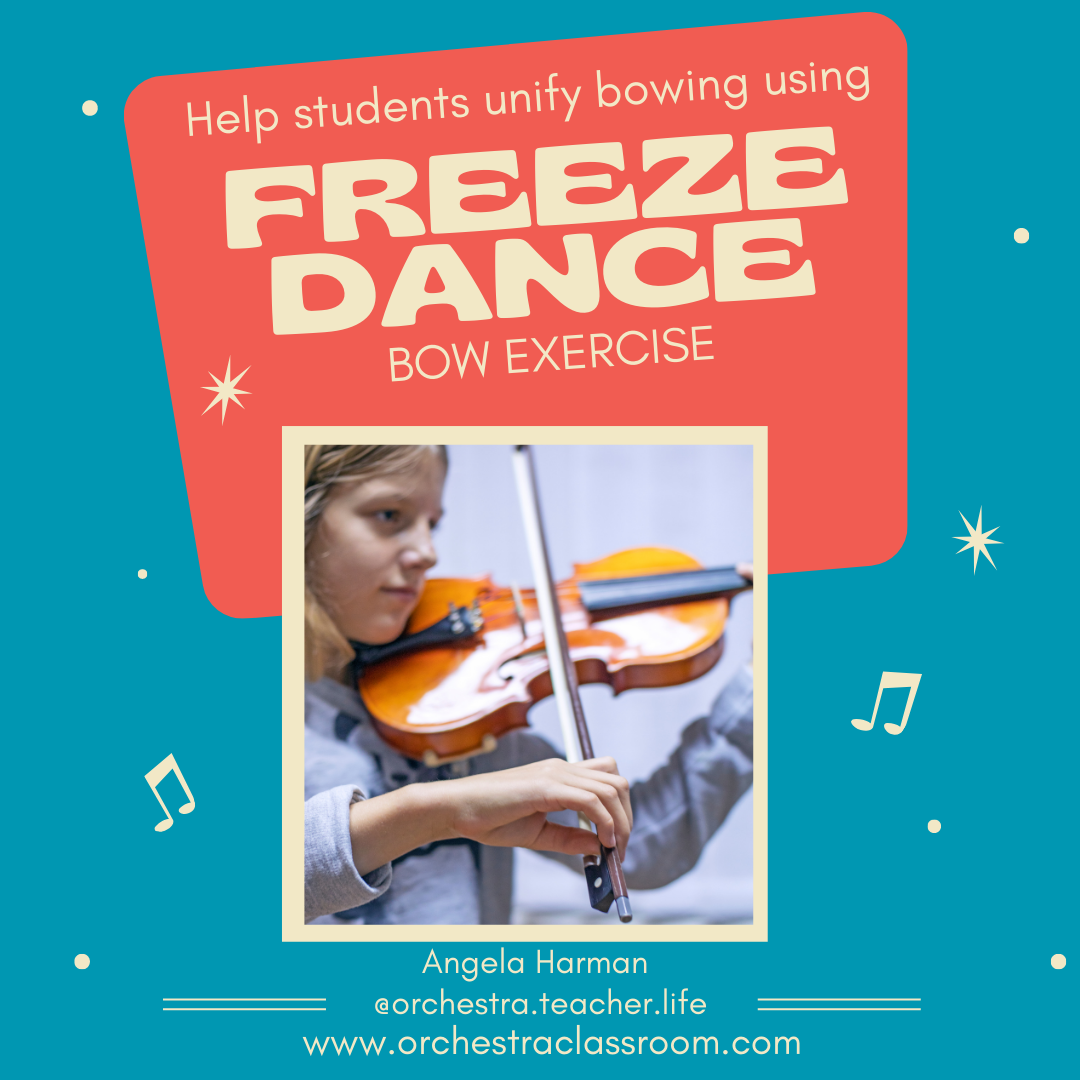
Freeze dance rehearsal game for unified bowing


This week I wanted my orchestra 2 (2nd year) orchestra students to work on unifying bow strokes.  We watched a performance from TwoSet violin where they played a duet and their bowing very well matched.  Even while playing different parts/notes, their bow strokes were unified: (watch just the first part when they were using full size violins).  We also talked about tone and how to get the most sound from our instruments...no matter the size.


We talked about the importance of unified bow strokes and having everyone use the same amount of bow as well as matching bow placement, weight, speed. etc.  To practice the skill, I selected short one measure rhythms from our concert music.  I then used a YouTube FREEZE dance video to practice each rhythm:


For example, all students should play one note - low A.  They all perform the same rhythm over and over (on low A) using the same bow strokes/same amount of bow until the video says to STOP/FREEZE.  Once frozen, all students check to see if they are in the same part of the bow as everyone else.  I paused the video as everyone froze.  I then demonstrated a new rhythm for the next portion of the freeze dance, so we worked on 6 different rhythms total.

This game worked really well to help students match bowing, be aware of others in the ensemble, and master rhythms from our music.  After playing this game, my students sounded much more unified in their concert music.

Thursday, March 16, 2023

St Patrick's Day in Orchestra


I don't normally celebrate St. Patrick's day, but my students have been working so hard to learn their music I feel like it's time for a Friday Fun Day game.  This game can really be modified to be played at any time, but a leprechaun theme makes it a little extra entertaining....you'll see why.  :)

This game takes very little prep work.  I already know the passages of music that have been difficult for students to master.  I created a few slides with note sequences from our concert music, but after those slides, I'll be having students play certain measures from their parts.  Here's how to play!


1. Make a wheel with 'leprechaun dares.'  These are things the teacher or a student volunteer will do IF students are allowed to spin the wheel.  I make wheels at pickerwheel.com.

Here are my leprechaun dares:

  • Skip around the room
  • Open the door and yell "I love Leprechauns!"
  • Dance to some Irish music for 30 seconds.
  • Walk to the office and tell them you've lost your gold.
  • Say something in an Irish accent.
  • Pass out gold coins to stellar students as they play correctly...
  • Direct the orchestra like a leprechaun
  • Try to distract the group as they play. If you see a mistake, you can take their gold coins.
  • Jump up and click your heels together while yelling, "It's an orchestra life for me!".
  • Find a leprechaun friend. Give them a headband to wear for the rest of the day.
  • Pick someone NOT wearing green dance with you. If they do it, give them a green necklace.
  • It's your lucky day! As students play, leave suckers on the seats of students who have great posture/position.

Here's a link to my wheel: https://pickerwheel.com/pw?id=K4j7Z


2. The whole class or a certain section will be called to to play specific measures as chosen by the teacher.  If they play correctly, the wheel can be spun and all can enjoy watching the student volunteer or teacher (as the'leprechaun') do the dare.  If not played correctly, the class will rehearse and fix the measures, but they will not get to spin the wheel.

3.  To make this extra funny, the teacher or the student volunteer can dress up in a costume.  I happen to have this hilarious costume already...

4.  I stopped by Hobby Lobby to buy a few extra props for the game:  Gold coins for the 'leprechaun' to pass out to stellar students, shamrock necklaces to pass out to students NOT wearing green, and festive green headbands for selected students to wear during some of the dares.

Saturday, March 11, 2023

Top Tech Hacks for orchestra teachers - time to sign up!

I just finished teaching Top Tech Hacks for orchestra teachers to learn how to create their own resources/worksheets/assessments and it was AWESOME! Can't wait to do it again. My first class sold out in less than 24 hours. Don't miss out! Here's a link to my next class! https://www.eventbrite.com/e/top-tech-hacks-how-to-create-your-own-orchestra-resources-tickets-582264136707


Saturday, February 25, 2023

Tech Hacks for Orchestra Teachers


Click here to enroll!


Have you always wanted to create your own awesome orchestra resources for your students?  I can show you how using Google Slides!  No add-ons, no expensive programs or software required.  (Though I will demonstrate options using Sightreadingfactory.com (free at first, $35 subscription for a year) and Flat for Education (free trial, then $2 per year).  

This course will give you ideas, know-how, and inspiration to create meaningful, relevant classroom materials for your students.  There are 6 segments in the course, each with an project where you will create your own resource:


1: Basic Settings to turn Slides into a powerful publishing tool
2: Make your own fingerboard worksheet
3: Create your own note-naming worksheet
4: Create your own rhythm assessment
5: Create your own sight reading or note assessment
6: Create your own custom practice assignment


CLICK HERE TO ENROLL!


Along the way, I will show you tips and hacks for creating professional-looking content in an efficient manner.


You will also receive FREE TEMPLATES to use as ideas or for building blocks in your own creations.


Only 15 spots open for this first class!  Reserve your space today!  This class is LIVE over Zoom. 

March 11, 8 am MST

https://www.eventbrite.com/e/top-tech-hacks-how-to-create-your-own-orchestra-resources-tickets-550163683387