Search This Blog

Saturday, July 30, 2022

This just in! Ninja themed assessments with rubrics for beginning orchestra


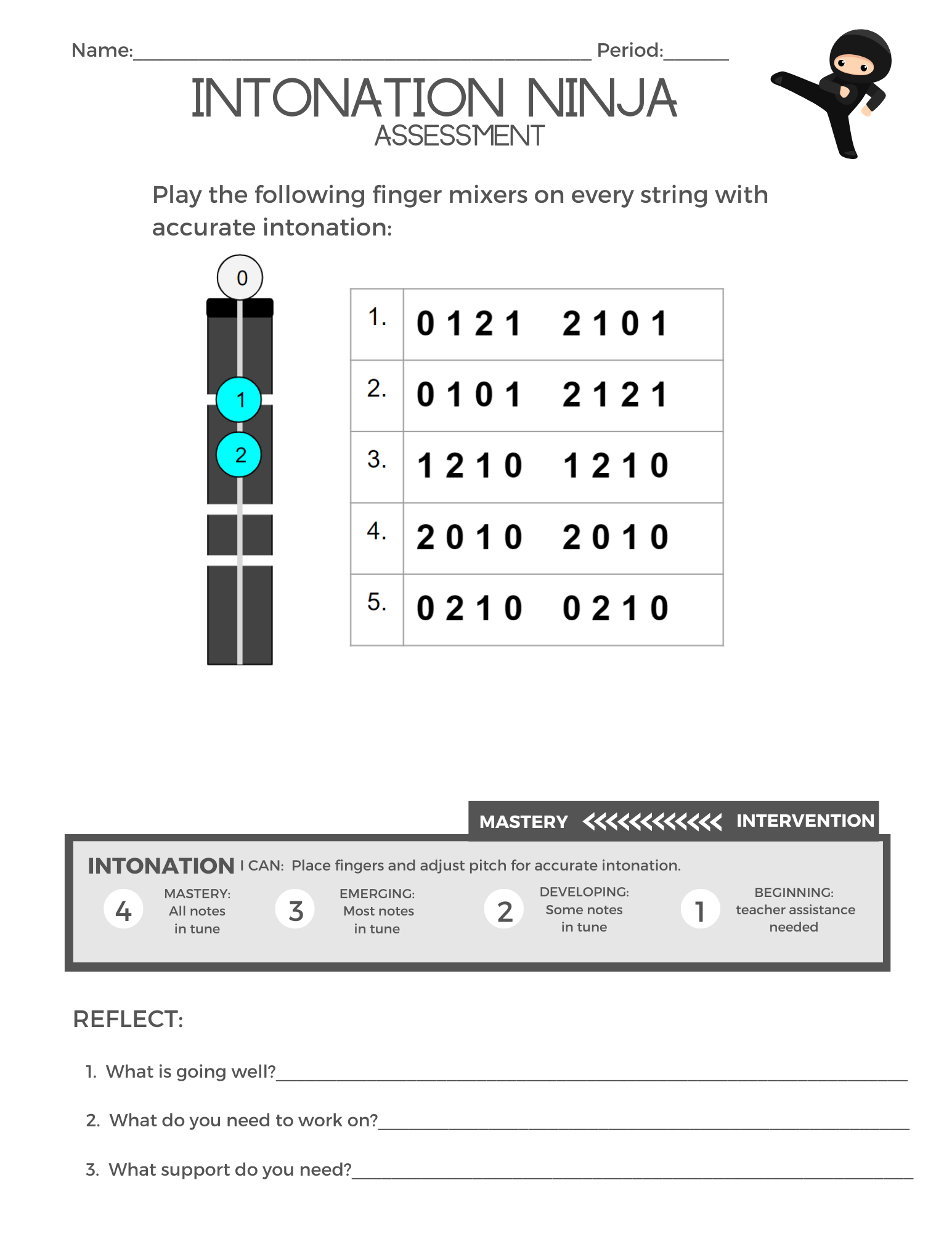
This just in!  A collection of 24 assessments for beginning orchestra with rubrics and excerpts on each page. All pages are ninja themed as students work to achieve mastery in the areas of bow hold, bowing, intonation, position, and finger patterns (Bornoff 1 and 2 on D, A, and G strings).  These would work great for orchestra karate belt  pass offs, or for regular playing tests.  

PURCHASE HERE!

BONUS: On the last page of this resource is a link where you can access the entire template to make adjustments or changes to suit the needs of your students.  So this resource is EDITABLE using a Canva.com account.

Can't wait to use this with my students!

Here are a few sample pages:


Thursday, July 28, 2022

Playing test and assessments rubrics


I have tried many different ways to assess students.  I personally don't use practice cards use home practice time as part of my students' grades.  Instead, I grade written assignments (bellwork and other written activities that reinforce music theory, note-reading, rhythm, etc.) and playing tests where students demonstrate specific playing skills.  Students are encouraged to re-take playing tests as needed as they strive to master playing skills.  

Playing tests in my classroom used to be very time intensive.  I would listen to every student play a passage and grade each one using a rubric and write comments directly to each student.  While waiting for their turn to play, students would complete a lengthy written assignment, which would take me a very long time to grade later on.  One day after a playing test, I noticed my classroom garbage can overflowing with discarded playing test forms.  The grades, the comments...all trash.  I realized my playing tests were not super effective for student reflection and growth.   Since then, I have made some small changes in an effort to make playing tests more useful for me and my students.  This includes moving towards standards based playing tests where students are working to reach a pre-determined level of mastery.    Here is how I am currently running playing test assessments:

1. I choose a specific skill or passage and keep it simple and short.  I used to grade on everything: bowing, rhythm, intonation, notes, dynamics, bow hold, position.  I now choose the top skills I want students to focus on and tailor my rubric to match.  That means I don't always use the same rubric.  I use a variety of rubrics to fit the requirements of my learning targets.

2. I give students a pre-assessment.  I want students to know how to assess themselves and each other.  The grade doesn't always have to come from me.   Students perform a pre-test for their stand partners and fill out the rubric.  Students are able to support and help each other as they reflect on how to improve.  It only takes about 5 minutes for my class to complete a pre-test and grade each other.  Students then spend approx. 5 minutes writing down answers to a few questions: 1. Do you agree with the score your stand partner gave you?  2.  What do you still need to work on?

3. Based on pre-test results, I help the class as much as possible to master the necessary skills for the playing test.  Sometimes, I create specialized practice worksheets to help students break down passages to practice slowly and carefully.

4. Using the same rubric as the pre-test, I listen to every student individually.  Because playing test passages are short and specific, this does not take too much time.  I give students the rubric with their scores right after they play and students answer a few questions to reflect of their playing.  Students who have anxiety are allowed to submit their test online.  While students are waiting their turn, they work on other essential music skills.  Not on a long boring worksheet, though.  They do activities on chromebooks, experiment with composition, work on listening skills, or practice notereading/rhythm. 

5. Sometimes I do something totally different than a playing test and have students track their skills throughout one rehearsal or even one week of rehearsal.  Variety is good.  

Here are a few sample rubrics:

This rubric is for students to check themselves every day for accurate posture, bow hold, position, and left hand placement.  The idea is for students to be responsible for mastering these skills throughout one week of rehearsal.


Pre-Assessment:

Playing Test Assessment:

Notes/Intonation Rubric:


Bowing Rubric:


Term 1: Mid-Term Rubric - student self-assessment:


Tuesday, July 19, 2022

learn from barbie - don't buy cheap violins!


We’ve all been taught to shop around and be smart with our money.  Especially with larger purchases.  It makes sense to look for the best deal.  I do the same thing.  But sometimes, despite my best intentions and thorough research, I’ve ended up with a product that ended up being more junk than deal.  Once I bought my son a couple of huge brick building sets that looked a lot like Legos, but were a different brand.  They were WAY cheaper than Legos and I was feeling pretty proud of myself for saving money.  On Christmas morning we began to build and soon discovered the pieces would not align properly, no matter how hard we tried.  Our structure would not stay together and there was a lot of frustration and tears.  We were following the directions.  We were qualified builders.  But the set did not allow us to get a successful result.  The discount building sets were in the garbage before lunch time.

My children learned a similar lesson from buying toys at a local dollar store.  One of my kids wanted a Barbie and was excited to find something that looked like a Barbie for only a dollar!  Once home it was easy to tell that a dollar doll and a Barbie doll are not really the same at all.  A dollar doll has a huge ugly bald spot on the back of her head and her hair falls out way too easily.  Her arms and legs won’t bend, and worst of all, her head pops right off!  My children finally learned it is better to save a little more money and buy something quality made that will last longer.

I recently saw a post on facebook that broke my heart a little.  A mom had posted a question on facebook about where she could find a cello.  People responded with some worthwhile suggestions and good information.  After all of that, the mom said, “Thanks for your help, but I found one on ebay with everything I need for only $145.   It will save a lot of money!”  This well-intentioned mom doesn’t know that the instrument coming in the mail is about to cause some grief and the student using it will struggle. 

Parents don’t always realize that when looking for instruments, there are drastic differences between the ‘lowest best deal online’ and an actual playable instrument.  They can look so similar. It is very deceiving. 

Why do these inexpensive ebay/amazon/online instruments cause grief?  Let me explain. 

Grief #1

The instrument will look like a string instrument, but the pieces won’t be fitted together correctly.   It’s like buying a puzzle that hasn’t been cut right so the pieces don’t quite fit.  Because of this, the instrument will be almost impossible to tune.   A patient teacher can get it pretty close, but it will never maintain a correct pitch for long.  Strings will constantly be stretching, pegs will constantly be slipping, and the instrument will not sound right.  

Result:  Everything that is played on the instrument (even when it is played correctly) will sound off and out of tune.  The student will think he/she is not as good as the others because the sound from their own instrument doesn’t match the group.  Often the student will begin to doubt their own musical ability and question their choice to learn an instrument.    The student might feel others in the class are more talented, when really the difference was only the quality of the instrument.


Grief #2

The instrument can only deliver a small, thin, sound.
Quality instruments are made from only specific kinds of wood which are carved in certain ways to create the best possible, resonant sound.  Discount instruments are made from inferior materials.  The wood and strings on a discount violin can not produce the same full, ringing sound as quality instruments.

Result:  The student can not hear him/herself while playing in a group.  When a student can’t hear the tone from their own instrument, it is very difficult to make small adjustments necessary to improve and fix intonation.  The student will learn to play out of tune.  The student will then believe he/she has little talent and may become frustrated. 


Grief #3

The instrument comes with many parts that will immediately need to be replaced.
The pegs in a ‘discount’ instrument are not fitted correctly, the bridge has not been shaped correctly (making it harder to play on one string at a time), the strings are too thin (making the sound too soft), and the fine tuners won’t work. 

Result:  To make the instrument playable, it will need new pegs, new bridge, new strings, and new tailpiece.  The discount instrument now requires an additional $200+.  Money that could have been used to purchase a quality instrument.


It’s wise to do research and to find good deals.  When it comes to instruments, please don’t be deceived by what we call VSO’s (violin-shaped-objects).  They look like the real thing, but are actually impostors.  These inferior ‘instruments’ won’t help students progress and learn and they make learning harder.  For a student to succeed, they must be given quality materials.  A quality instrument sets students up for success.  Some parents may be worried about investing money into an instrument when they are unsure if their child will like it or not.  Don't fear.  A child who has an instrument that works correctly and sounds good will LOVE it!  

 Please seek advise from your teacher when looking for an acceptable instrument.  Visit your local music stores and have them tune and play their instruments for you.  A student’s success in music depends on this most important step – finding a quality instrument that fits together properly with working pieces, stays in tune, and offers a full resonant sound.

Monday, July 18, 2022

Fix Left Hand Position violin viola cello bass


One day I had a student come to my beginning orchestra class with each of her fingers bandaged because she had accidently cut herself while trying to chop an orange.  As we were playing through warm-ups, she exclaimed, "Wow!  It's so much easier to remember to keep my fingers tall and land on my fingertips!."  I joked that everyone needed to bandage their fingers to get the feel of maintaining tall fingers...then an idea popped into my head.  I grabbed my tape dispenser and passed out tape to all of my students.  They wrapped the tape around their fingers like bandaids...and we continued on with our rehearsal.  My classes tend to be large and it's so nice to have a technique that helps all students fix their own position.  This helped many of my students get the proper feel for left hand position.  It works for cello and bass players, too!  Now that I've done this a few times, I recommend using washi tape because it's more thin than regular tape and more comfortable to keep it on your fingers.

Collapsed knuckles, flat fingers.


Fun Washi Tape comes in all types of designs and it's cheap!


Wrap... not too tight!


Tell students not to let the tape touch the string.  Instant improvement!


Tuesday, July 12, 2022

Follow me for more orchestra class games, tricks, and tips!


Do you follow me on facebook and instagram?  I often share tips and tricks on those accounts and I don't want you to miss out!  Check it out!


Instagram:  @orchestra.teacher.life
Facebook: www.facebook.com/orchestraclassroom


Here are just a few ideas you will find there...

Pass the pig game for reinforcing bow holds and bow control:


Koala Punch Cards - to motivate students to develop perfect bow holds:


Fix those pesky collapsed pancake hands with a simple post-it note:


Tuesday, June 28, 2022

Frog Appreciation Day for Beginning String Orchestra students


Learning how to properly hold a bow is crucial for beginners.  It takes time, patience, attention to detail, and good fine motor skills.  Students are more likely to focus on the details and work to master bow holds when it is FUN!

Here are a few ways to make learning bow holds fun:

1. Have a 'Frog Appreciation Day.'


My students learn bow holds using straws on the first day of school.  Moving up to a real bow is a big deal!  You can make it extra exciting by highlighting the day as a celebration.  I designed a serious of 'Frog' posters and included them on a google slide presentation that helps teach students some bow basics:  parts of the bow, how to care for a bow, bow hold, bow exercises, open string cycle.  These slides contain a series of 6 activities students to celebrate 'Frog Appreciation Day.' You can download the presentation HERE ..adjust the wording on the slides to fit your own teaching style.  You can use the images on the slides for a fun set of classroom posters.


2.  Bow Hold Olympics

String players have much to think about while playing.  I've found it very helpful to isolate bow skills by having a 'Bow Hold Olympics' while students are learning to master bow holds.  This involves one entire class period practicing only bow skills.  I clean up all chairs and stands and students spread out to complete various Olympic events.  The open space allows me to freely walk through the group and help students are need to make bow hold adjustments.


You can design you own Olympic bowing events, or use my slides HERE.  8 total event challenges are included with descriptions on each slide - 22 slides total.  Some challenges require teams for relay-type events while other events are individual.

Wednesday, June 22, 2022

Rounds for Beginning Orchestra Warm Ups and more


Last year, I noticed I was getting in a bit of a 'warm-up rut.'  I kept doing the same old warm-up routine and was needing some variety.  It was time to re-energize warm-up time with something new and fun.  I started using rounds as warm-ups and my students loved it!  Students enjoy learning rounds. They are quick to learn because all parts are unison. When ready to try as a round, there are so many possibilities!


Rounds are very versatile.  Here are a few ways to use rounds in your classroom:


1. While in unison, you can focus on intonation, rhythm, and bowing skills. Once students are ready, divide into 2 parts and try the round.  Beginners especially love to hear the new harmonies and it motivates them to keep playing.  The round adds depth and helps students listen/tune pitches. Students must carefully count and maintain a steady tempo. These are important ensemble skills that will strengthen your group as you move to more complex ensemble music.

2. When dividing into 2 parts, use a variety of combinations: upper strings/lower strings, stand partners, rows, birthdays Jan-June/July-Dec, Marvel vs. DC, etc.

3. Rounds are great to use for student group projects. Allow students to form small groups and learn a round together to perform for the class. Rounds provide a basic foundation for future chamber work. Students can form small groups using any instrument combination and easily work together since parts are unison. Students can creatively create arrangements/variations of the round to perform.

4.  Rounds are a fun way for students to practice together! Encourage students to get together with friends to learn and harmonize together.

5.   Rounds can be easily performed. There are a variety of ways to arrange a round to work in a concert setting. (For example, play one time in unison, play as a round, one section plays melody, play as round with different grouping of students,.etc.)

6.  Many simple rounds are played on only 2 strings: D and A. Try having students play each round on the G and D strings.

7.  Try changing the key signatures to create a different sound and rehearse alternate finger patterns. Teach advanced skills like shifting/fingering options as a way to differentiate in a mixed class setting.


I just finished writing a resource called "Rounds for Warm-Ups" available HERE.   Traditional rounds are included as well some some original compositions.  This resource contains a Conductor Score, Rote pages for each round, Parts for Violin, Viola, Cello, and Bass. 62 pages total.  16 rounds included.  BONUS: Access to the rounds on google slides is included to use as a visual while teaching.   


Thursday, May 19, 2022

End of Year after concert game


After the final orchestra concert there's a lot to do.  Inventory, music collection, music filing, summer rentals, instrument cleaning, locker clean-out...the list can go on and on.  It's nice to have a fun activity for students to do that can free you up to complete some end-of-year  chores.

This game is inspired by a board game called 'Loaded Answers.'  Here's how to play the orchestra version:

Make double-sided game sheet - one side for answers, the other side with questions.  Here's a LINK to my form.


Have students divide themselves into teams of 5-8 people and sit in a circle.


This game is fun, easy, and students can keep it going by themselves.  Great for end-of-year or for a sub plan!


You can make your own questions or find questions online...there are many sites that lists of questions for kids.  Here's my list:

  1. If you had to play one specific piece of music every day for the rest of your life, what would you play?

  2. What would immediately get you out of a bad mood?

  3. What is an abnormal thing to say to your orchestra teacher?

  4. Who should be locked in an instrument locker?

  5. What would be the most embarrassing mistake to make at a concert?

  6. If you could buy anything in the world, what would you buy?

  7. What musical instrument do you feel should be banned?

  8. What is your favorite orchestra memory?

  9. If you had to eat just one type of food for the rest of your life, what would it be?

  10. If you could do anything right now, what would you do?

  11. What do you look forward to when you wake up?

  12. If your stuffed animals could talk, what would they say?

  13. What bothers you?

  14. What is something you want to do this summer?

  15. If you were a teacher and could teach your students anything, what would you teach them?

  16. What do you daydream about?

  17. If you opened a store, what would you sell?

  18. What is the best thing that ever happened to you?

Saturday, April 30, 2022

Among Us Rehearsal Game for String Orchestra


All week I've been using an 'Among Us' theme in my orchestra rehearsals.  On Monday, we worked together to identify measures that sounded 'sus' (or suspicious).  I broke those measures down into small warm-ups to help students master the necessary skills to improve.  Framing our rehearsal in this way kept students motivated to do the hard work and repetitions needed to help the group sound better.  On Friday, our big reward was to play AMONG US!  At first I was worried about playing the game because I didn't want to waste rehearsal time with only 2 weeks to go before our next concert.  I didn't need to worry because this game actually helped my students a TON.  They were learning, assessing, listening, and practicing with maximum effort. 

To introduce the game,  I found some great mood music on YouTube and incorporated it onto my slide so while I went over the rules, 'Among Us' music was playing.  It made students SO excited to play and they listened extra carefully to the rules with the dramatic music in the background.  


To play the game, I used google slides to show students a sequence of notes to practice.  We practiced the sequence together until students were all playing it correctly.  Some of these were warm-ups I designed to work on specific skills while others were specific measures from our concert music.  Next, I started the mood music (just clicked on the YouTube video I put on each slide) and students bowed their heads, closed their eyes, and held their bows up in the air.  The room was completely silent and still as I stealthily walked around the room and used my bow to gently tap the horse hair on the bows of 4 students...who then became the imposters. 


Next, I asked ONLY the imposters to open their eyes and look at the screen.  There they would discover their 'secret weapon.'  Imposters had to play the exercise with the 'secret weapon' technique to try to destroy our sound.  

 
All students opened their eyes while I switch the slide back to the original warm-up/note sequence.  We played the sequence while crew members tried to find anything in the performance that seemed 'off.'  Students were allowed 4 guesses after each round.  We played 3 rounds for each slide.


Students who were called out and NOT the imposter became ghosts.  They were allowed to roam the room and point at students who were 'sus' ....to help the crewmates narrow down who to guess for the next round.


We played this game with 5 different note sequences/warm-ups.  I kept the pacing quick and we got a lot done.  Students were striving to play correctly and they listened so carefully to each other.  I could definitely hear improvement when we ran through out concert pieces after the game.


Tuesday, April 19, 2022

Spring fever? 5 rehearsal games to re-focus


Spring break is over.  We're in the home stretch and we're all feeling antsy.  It can be hard to maintain a focused rehearsal when everyone is trunky for summer vacation.  Here are a few games to get students moving, listening, and focusing.  My students are grades 6-7 and they love these games.  I think older and younger students would enjoy these as well!  

1.  Signs

In an ensemble, students must be aware of other players and match technique, intonation, bowing, etc.  In this game, students practice paying attention to a 'leader' and must imitate every action the leader does.  Have students sit or stand in a circle.  Choose one student as a guesser and have them stand in the corner with eyes closed or in the hall while the group chooses the leader. All students follow the actions of the leader while the guesser enters and circle and watches to guess who the leader of the group is.  The leader should keep changing up movements as the group follows.  The guesser has 3 guesses.  This game could also be done while sitting as a regular orchestra ensemble...it's more difficult, but it teaches students to find ways to 'watch' and be aware of each other.

You can do a similar game with bowing in a rehearsal.  Choose a student to stop their bow...and every other student must stop their bow when the leader stops.  Or a leader can switch to pizzicato and the group must also switch to pizzicato...etc.  It gets students really listening and paying attention.

2. Pass the Beat Around the Room

The easiest way to explain this one is to watch THIS VIDEO.

This game is more fun than it looks.  It requires concentration and focus...so silly mistakes will be made.  Once students have the pattern, we replace the word 'beat' with a hand clap.  If a student says ' beat,' they are out.  Then we replace the word, 'room' with a foot stomp.

This game helps students maintain a steady beat and focus on what comes next.  It's a great way to get a group moving and thinking.

3. Zip, Zap, Boing

This is a quick-thinking group game that re-energizes students and activates their brains to pay attention, follow directions, and focus!  Read the ZIP, ZAP, BOING instructions HERE.   After you read the rules, watch THIS VIDEO to see how it's done.  My students loved this one!

4. Eyes

This is a fun elimination game.  It can be used to practice moving, responding to certain beats in a measure.  While stand in a circle, have all students put their head down.  You can start some music or a drum beat.  Have all students lift their heads and look at anyone else in the circle on beat 4.  If they make eye contact with another person, both people are out.  Continue until one person is left.

5. Silent Ball

I love this game because it's quick paced and SILENT!  If your class is noisy and driving you crazy...this is the game for you.  The game teaches coordination, self-control, and awareness.  Here's how to play:  1. Put all instruments away for safety.  2.  Students stand on a chair.  3.  No talking...if a student talks, they are out and must sit down.  3. Using the lightweight bouncy grocery store balls, have students gently toss a ball to each other.  Students must pay attention to where the ball is and catch it when it is thrown to them.  If they don't catch the ball, they are out and must sit down.  4. If a student does a bad (uncatchable) toss, that student is out.  5.  No throwing a people's backs.  6.  Forming alliances is allowed. 

Once students get good at tracking one ball, I start to add up to 2 more balls.  It's tricky to keep track of multiple balls in play.