Search This Blog

Tuesday, October 4, 2022

Orchestra Inc rehearsal game in Monsters Inc style!


Try this new fun rehearsal game - ORCHESTRA, INC!  Perfect game for the month of October to get rid of any  'scary' sounds/habits coming from your students.  :)

Just click on the number above each door to reveal the challenge behind the door.  Customize the Powerpoint by changing the text to match your pieces and curriculum.


Wednesday, September 28, 2022

Note Reading Worksheets: Note Stories!


Now available!  3 note reading stories where students write the note names to discover the missing words in the 'story.'  My students LOVE doing these worksheets.  Today they told me it was the most fun worksheet for note reading I had every given them!   3 different stories in all 3 clefs:  treble, alto, and bass clef.  9 worksheets total.  PURCHASE HERE!


Thursday, September 8, 2022

Ninja skills tracker for beginning orchestra


THIS WORKSHEET worked wonders in my beginning orchestra class. It shows each skill students must master in order to learn 'Twinkle Twinkle Little Star.' In class, I began the activity asking students to become teachers by helping 'grading' their stand partners on each skill. I prepared students by having them grade a sample of my playing during a demonstration. Students were told they could NOT go on to the next belt until the previous belt was mastered. Each skill builds on previous skills, so posture, bow hold, and left hand position must stay consistent throughout in order to keep passing off belts. Stand partners then worked together to assess each skill. They spent time practicing together when needed in order to keep moving forward. The vast majority of my students earned the black belt in about 25 minutes. After doing this worksheet, my classes sounded transformed! Twinkle became a piece of cake. :)

Get yours HERE!


Thursday, September 1, 2022

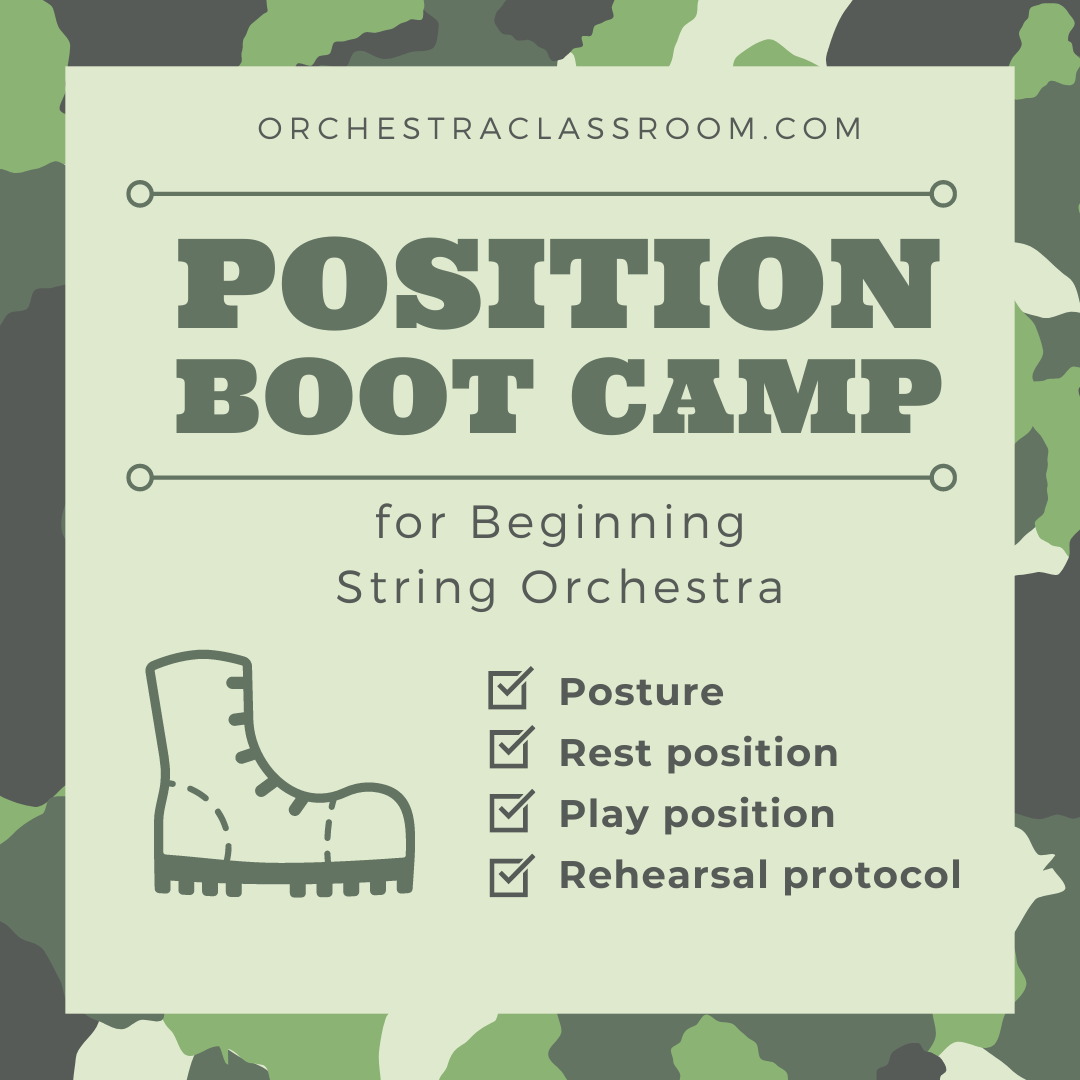
Beginner boot camp day for position and rehearsal protocol


My beginners have been playing for about a week.  They are learning how to handle instruments and bows and how to manage holding/playing instruments during rehearsals.  In order to establish great position and positive rehearsal habits, I held a 'Position Boot Camp' day.  Here's how I did it:

1.  Dress up in camo gear.  All I had was a jacket, but maybe I can add to my wardrobe some day. :)

2.  Show part of the following video to demonstrate how a well trained military group handles equipment.  They are disciplined.  They move at the same time.  All soldiers know their part.  It is synchronized.


3.  Show just the first part of the following video to show how much self-control is required of soldiers.  In orchestra, it can be difficult to NOT pluck/play instruments and hold still when listening to instructions.  It's important to develop self-control to play only when directed.  In orchestra we play when I give the following command:  'Ready, play!'


4.  Act like a drill sergeant while teaching students how to handle equipment.  Teach rest position, ready position (violin/violas on knees, all bow hold get set are are held vertically on right knee), and play position.  Once in play position, students place bows on the strings without making a sound.  Bows not begin playing until the command 'ready play.'  Use drill sergeant voice while practicing:  "Sit Tall."  "Bows up"   "Left hands set!"   Short commands work great.  This really helps clean up rehearsals as students remember to play only when directed.

5.  As a reward, use a rubber chicken to try to distract students.  Squeak chicken while students are playing to see if they will stay focused.  Have students line up and squeak the chicken by each student to see if they can keep a straight face.  (It's all about practicing self-control)


Tuesday, August 9, 2022

First Impression


I teach at a middle school where students are rotating through classes for the first time.  Our school hosts a '6th grade day' where students attend each of their classes for 5 minutes to help them practice their schedules.  This is the first 5 minutes I get with my beginners.  It can be difficult to choose what to cover in such a short amount of time.  I decided the most important thing to is create a good impression that leaves students excited for my class.   In previous years, I did a presentation about how orchestra is your 'ticket' to many amazing opportunities.  It always went really well, but I've been doing the same thing for so long...I decided to change it up.  

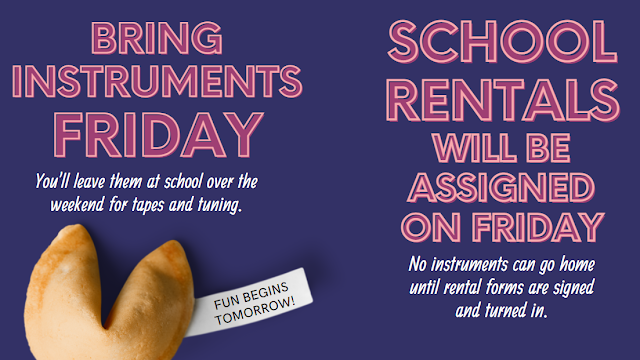
This year, I'm using a presentation I made at Canva.com to show students their 'future fortune' in belonging to orchestra.  At the end, each student will receive a fortune cookie eraser with a custom fortune.  (I take out the fortunes that come in the eraser and create my own orchestra fortunes.)  You are use my canva template for free HERE.


Friday, August 5, 2022

Orchestra Student Binders


I decided to make binders to keep on every music stand in my classroom.  I got this idea from some awesome teachers in Georgia - shout out to Amy Clement and Sarah Ball!  

Every minute counts in an orchestra rehearsal.  By placing materials in binders, every student will have what they need.  No more hunting down music for that kid who was absent, or making a new copy of our warm-ups because somebody left theirs at home.  I'm still going to give each student a folder and music they can take home for practice, but binders will stay at school on the music stands.  

Just filled my binders today and I'm excited to use them!


Here's what I'm putting in my binders:

1. I designed a fun cover for each instrument:


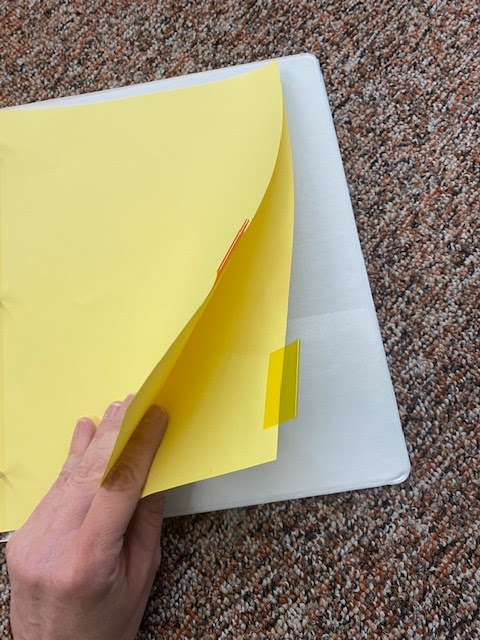
2.  File tabs to separate each section:  

Part 1:  From Rote to Note - this a resource I created and my current fav. to use to get beginners started.


 Part 2:  Bornoff Primer - this is my first year using Bornoff and I'm excited to use this with my beginning and intermediate groups as warm-ups.  Available at fase.org


 Part 3: Rounds for Warm-ups - this is a resource I created and will use these for ensemble skills and warm-ups


Part 4: Fingerpattern drills - this is a resource I created for students to practice fingerpatterns on every string by key signature.


 Part 5 and 6  This is where I'll put the concert music for my beginning and intermediate classes.  (I haven't chosen music, yet...so it's empty)


Saturday, July 30, 2022

This just in! Ninja themed assessments with rubrics for beginning orchestra


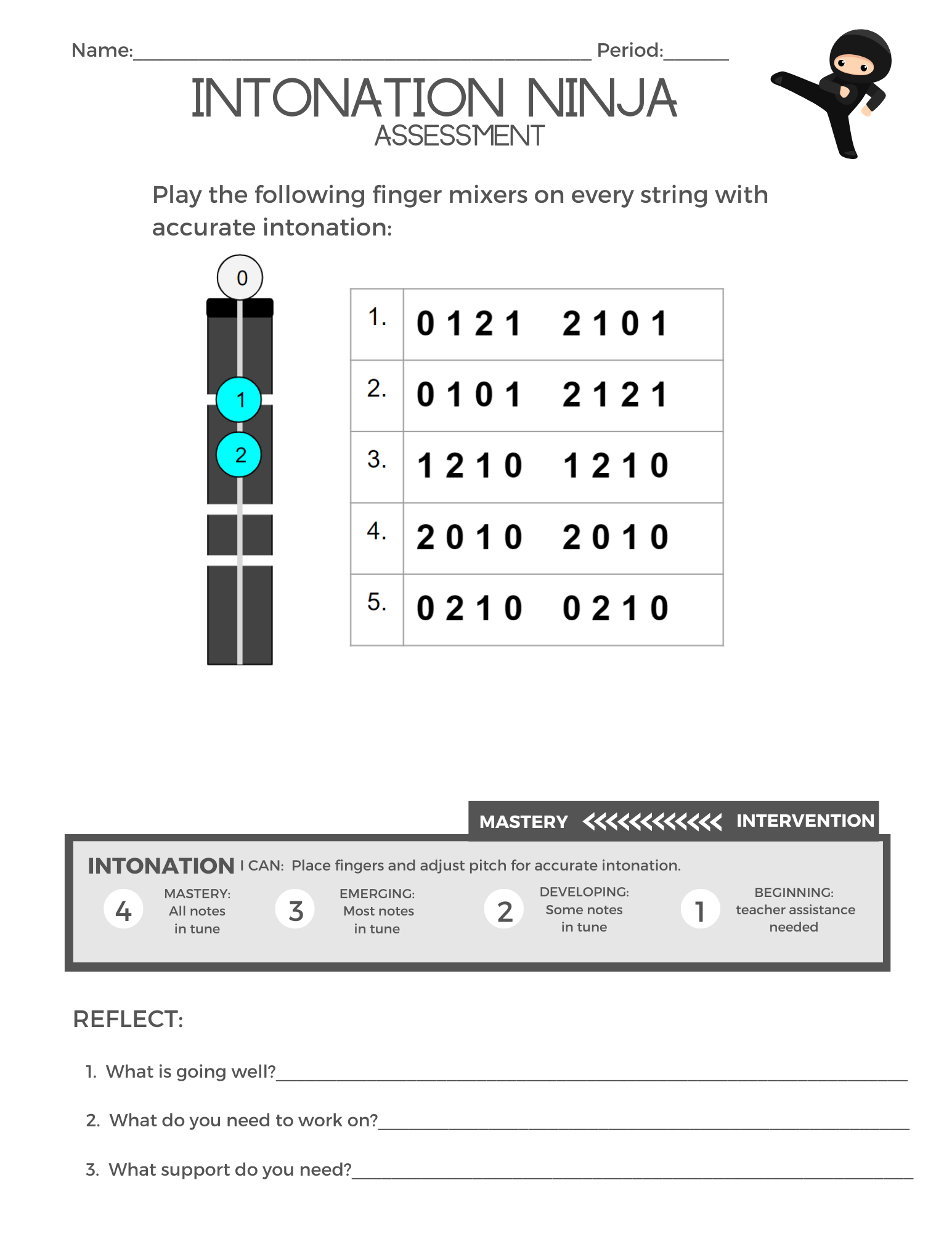
This just in!  A collection of 24 assessments for beginning orchestra with rubrics and excerpts on each page. All pages are ninja themed as students work to achieve mastery in the areas of bow hold, bowing, intonation, position, and finger patterns (Bornoff 1 and 2 on D, A, and G strings).  These would work great for orchestra karate belt  pass offs, or for regular playing tests.  

PURCHASE HERE!

BONUS: On the last page of this resource is a link where you can access the entire template to make adjustments or changes to suit the needs of your students.  So this resource is EDITABLE using a Canva.com account.

Can't wait to use this with my students!

Here are a few sample pages:


Thursday, July 28, 2022

Playing test and assessments rubrics


I have tried many different ways to assess students.  I personally don't use practice cards use home practice time as part of my students' grades.  Instead, I grade written assignments (bellwork and other written activities that reinforce music theory, note-reading, rhythm, etc.) and playing tests where students demonstrate specific playing skills.  Students are encouraged to re-take playing tests as needed as they strive to master playing skills.  

Playing tests in my classroom used to be very time intensive.  I would listen to every student play a passage and grade each one using a rubric and write comments directly to each student.  While waiting for their turn to play, students would complete a lengthy written assignment, which would take me a very long time to grade later on.  One day after a playing test, I noticed my classroom garbage can overflowing with discarded playing test forms.  The grades, the comments...all trash.  I realized my playing tests were not super effective for student reflection and growth.   Since then, I have made some small changes in an effort to make playing tests more useful for me and my students.  This includes moving towards standards based playing tests where students are working to reach a pre-determined level of mastery.    Here is how I am currently running playing test assessments:

1. I choose a specific skill or passage and keep it simple and short.  I used to grade on everything: bowing, rhythm, intonation, notes, dynamics, bow hold, position.  I now choose the top skills I want students to focus on and tailor my rubric to match.  That means I don't always use the same rubric.  I use a variety of rubrics to fit the requirements of my learning targets.

2. I give students a pre-assessment.  I want students to know how to assess themselves and each other.  The grade doesn't always have to come from me.   Students perform a pre-test for their stand partners and fill out the rubric.  Students are able to support and help each other as they reflect on how to improve.  It only takes about 5 minutes for my class to complete a pre-test and grade each other.  Students then spend approx. 5 minutes writing down answers to a few questions: 1. Do you agree with the score your stand partner gave you?  2.  What do you still need to work on?

3. Based on pre-test results, I help the class as much as possible to master the necessary skills for the playing test.  Sometimes, I create specialized practice worksheets to help students break down passages to practice slowly and carefully.

4. Using the same rubric as the pre-test, I listen to every student individually.  Because playing test passages are short and specific, this does not take too much time.  I give students the rubric with their scores right after they play and students answer a few questions to reflect of their playing.  Students who have anxiety are allowed to submit their test online.  While students are waiting their turn, they work on other essential music skills.  Not on a long boring worksheet, though.  They do activities on chromebooks, experiment with composition, work on listening skills, or practice notereading/rhythm. 

5. Sometimes I do something totally different than a playing test and have students track their skills throughout one rehearsal or even one week of rehearsal.  Variety is good.  

Here are a few sample rubrics:

This rubric is for students to check themselves every day for accurate posture, bow hold, position, and left hand placement.  The idea is for students to be responsible for mastering these skills throughout one week of rehearsal.


Pre-Assessment:

Playing Test Assessment:

Notes/Intonation Rubric:


Bowing Rubric:


Term 1: Mid-Term Rubric - student self-assessment: